

Introduction: Why AI in Restaurant Operations Matters Now
AI in restaurant operations is no longer a futuristic concept—it’s a practical response to very real pressures restaurant owners are facing today: having difficulty hiring enough staff, food costs are going up unexpectedly, and customers are looking for faster service, personalised experiences, and the same high quality every time they come in. AI can help solve these problems, making it easier for restaurants to meet their customers’ needs. AI can help restaurants by using everyday data to make better decisions. AI can help restaurants better schedule workers, predict food orders, and personalise customer experiences. These tools are changing how restaurants operate. It’s not just a question of whether to use AI in restaurants; it’s more about how to use it effectively. When used the right way, AI doesn’t remove the friendly feeling of serving people. Instead, it helps restaurant workers by giving them better insights, more control, and extra time to handle their busy jobs.
What AI Really Means in Restaurant Operations (And What It Doesn’t)
Let’s make this clear from the start. When we talk about AI in restaurants, we don’t mean that robots will take over the kitchen or that computers will run everything without any people involved. Instead, AI in restaurant management refers to software that uses data to help make better, faster decisions. It looks at a lot of information about how the restaurant runs to help make smarter decisions. Think sales trends, labour patterns, inventory movement, guest behaviour, and even weather-driven demand shifts. These systems learn over time, improving accuracy as more data flows through them.
Restaurant automation powered by AI works quietly in the background. It predicts how much food people will want, points out where things are not going well, and suggests steps to take—but people still make the final decisions. The aim is not to replace human feelings; it’s to back them up with data. New restaurant technologies do not make decisions based on emotions, do not get exhausted, and do not miss essential trends hidden in data. This is why both small and large restaurants are increasingly using AI tools for food service.
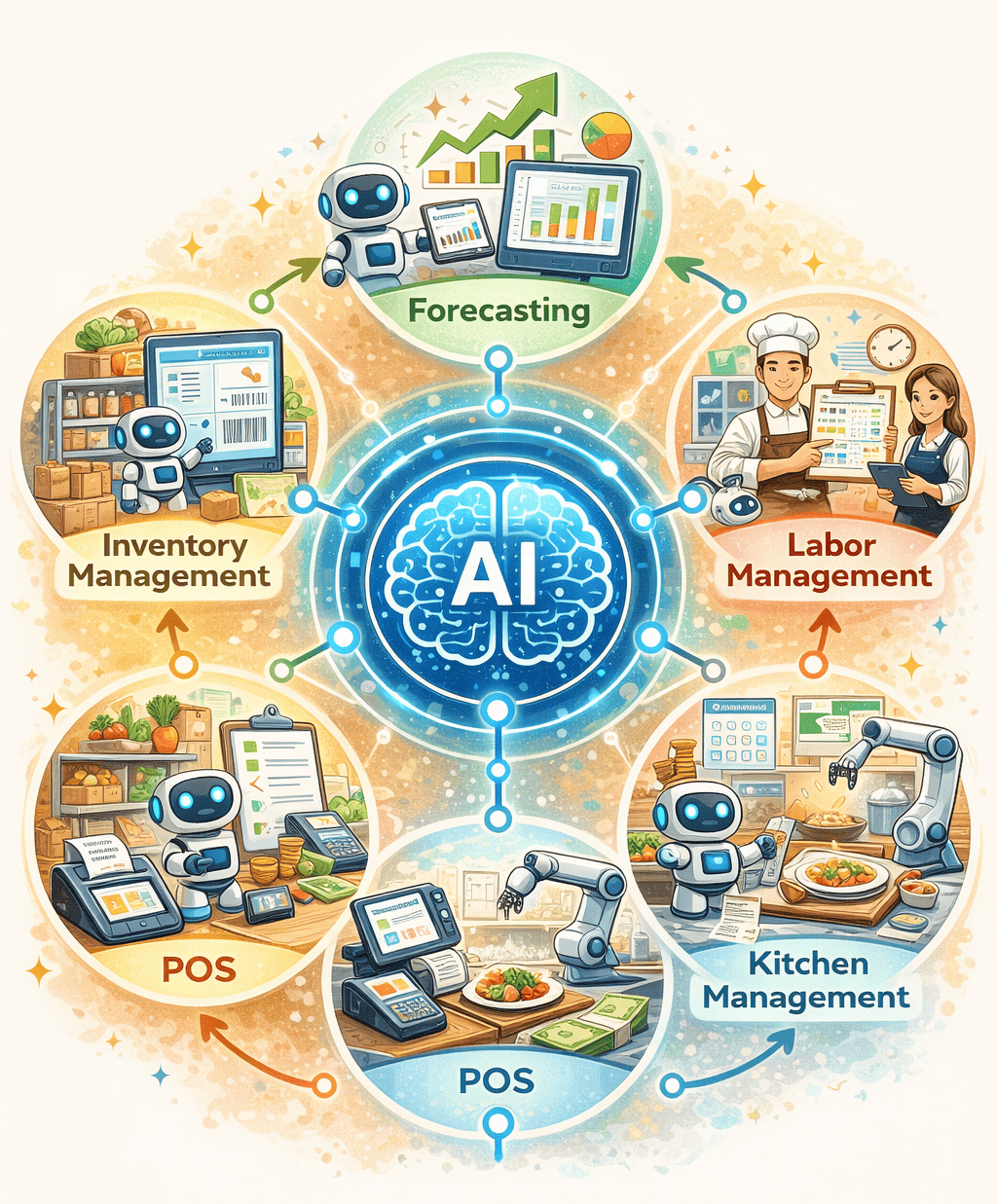
Importantly, AI is not a single tool. It’s an ecosystem that includes restaurant POS AI, AI inventory management, AI kitchen management, and restaurant data analytics platforms. When these systems are connected, operators gain a holistic view of performance—something that used to require hours of manual reporting.
The Operational Pressures Driving AI Adoption in Restaurants
Restaurant technology adoption rarely happens without pressure, and the last few years have delivered plenty of it. Labour shortages remain one of the most urgent challenges. The National Restaurant Association says finding enough workers remains a significant concern for restaurants of all kinds. AI labour scheduling tools help address this by accurately forecasting demand and aligning staffing levels with real needs, reducing both overtime and burnout.
Food cost volatility is another driver. AI inventory management systems analyse purchasing patterns, supplier pricing, waste levels, and menu mix to help operators control margins. Instead of reacting after food costs spike, restaurants can anticipate issues and proactively adjust orders or menus.
Customer expectations have also changed. Guests expect speed, accuracy, personalisation, and convenience—whether dining in, ordering online, or using third-party delivery platforms like Uber Eats or DoorDash. Hospitality AI solutions help restaurants meet customer expectations by improving order-taking, predicting busy times, and creating special offers based on what customers have liked in the past. These problems are not just a short-term issue; they show a big change in how restaurants must work to stay competitive.
POS Software For Restaurant Upgrade Every Restaurant Needs Right Now
AI-Powered Forecasting and Demand Planning
One of the most valuable applications of AI in restaurant operations is forecasting. Restaurant forecasting software uses machine learning to predict future demand based on historical sales, seasonality, promotions, local events, and even weather patterns. This isn’t guesswork—it’s probability modelling refined over time.
Many big restaurant brands, like McDonald’s and Domino’s Pizza, talk about how they use advanced technology to make their supply chains and staffing better. While smaller, independent restaurants may not have as much power, they can still access similar technology through restaurant software connected to systems like Toast POS or Square for Restaurants.
Good forecasting is important because it helps restaurants decide how much food to order, how many staff to schedule, and how quickly they can serve customers. Using AI technology helps avoid making too much food, reduces waste, and makes sure there are enough staff during busy times. This leads to smoother service and better profits—things all restaurant operators care about.

AI Inventory Management and Cost Control
Inventory is where profits quietly disappear. AI inventory management systems track ingredient usage in real time, compare it against sales data, and flag anomalies that may indicate waste, theft, or portioning issues. Over time, these systems learn what “normal” looks like for your restaurant.
What sets AI inventory tools apart from traditional systems is their predictive capabilities. Instead of just telling you what you ordered last week, they suggest the best amounts to order based on how much is expected to be needed and how long it takes for suppliers to deliver. This is very useful for businesses that have more than one store. It is important for them to have the same products available in all their locations.
Oracle Hospitality and Amazon Web Services (AWS) both provide technology for the hospitality industry that helps with these tasks on a large scale.Their platforms enable restaurants to integrate purchasing, inventory, and sales data into a single intelligent system.
Learn more:
- https://www.oracle.com/uk/hospitality/integration-platform/
- https://aws.amazon.com/travel-and-hospitality/restaurants/
AI Labor Scheduling and Workforce Optimization
Labour is both a restaurant’s greatest asset and its highest controllable cost. AI labour scheduling tools analyse sales forecasts, historical staffing data, employee availability, and labour laws to generate optimised schedules. This isn’t about squeezing employees—it’s about fairness, predictability, and efficiency.
AI restaurant management tools help managers prevent problems such as having too many workers during slow times or too few during busy times. These tools make things easier for managers by automatically creating schedules and adjusting shifts. As time goes on, the system gets better at finding the best ways to staff the restaurant for excellent service.
Starbucks has talked about using tools to schedule workers based on how busy it is, especially during periods when many customers come in. Although companies may use different tools, the main idea is the same: better schedules make workers happier and improve the customer experience.

Restaurant POS AI and Data Analytics
Restaurant POS AI acts as the central nervous system of modern operations. Systems like Toast POS and Square for Restaurants don’t just process transactions—they generate insights. AI-driven restaurant data analytics platforms analyse menu performance, modifier trends, upsell success, and guest behaviour patterns.
This intelligence helps operators make informed decisions about menu engineering, pricing strategies, and promotions. For example, AI can identify high-margin items that underperform due to placement or naming—and suggest adjustments.
When POS data is connected with AI kitchen management and inventory systems, restaurants gain end-to-end visibility. This integrated approach is what separates ingenious restaurant systems from disconnected tech stacks.
Best Restaurant Inventory Management System To Skyrocket Your Profits
AI in the Kitchen: Speed, Accuracy, and Consistency
AI kitchen management tools focus on execution. These systems optimise prep schedules, monitor ticket times, and balance workloads across stations. In high-volume environments, even small efficiency gains compound quickly.
Some quick-service brands use computer vision and AI models to monitor order accuracy and service speed. While this level of automation isn’t necessary for every restaurant, the underlying concept—using data to improve consistency—is universally valuable.
Domino’s Pizza has long been a leader in restaurant technology, using AI to track orders, predict delivery times, and optimise kitchen workflows. Their success illustrates how AI food service tools can support both speed and quality without compromising the guest experience.
Real-World Adoption: Why This Isn’t Just for Big Chains
Many people think that using artificial intelligence (AI) in restaurants is only for big brands. But that’s not true! New technology and payment plans have made it easier for smaller restaurants and independent owners to use AI, too. Big companies like Google, IBM, and Amazon provide strong AI systems that many restaurant tech companies use.
For example, OpenTable uses AI to help manage table bookings and reduce no-shows. Delivery services like DoorDash and Uber Eats also use smart technology to improve how they plan deliveries and guess what customers might want. These AI tools help restaurants run more effectively and make smarter decisions, even if the restaurant owners don’t realise they are using them.
Ultimately, the current landscape is characterised by greater choice and flexibility in adopting AI solutions. Restaurants can proactively adopt AI restaurant management tools—or continue reacting to problems after they occur.
Related article:
Best Restaurant Management Software
Best Restaurant Management Software UK
Best Restaurant Inventory Management System
Closing Thought
Using AI technology in restaurants is an important step to make them stronger and more efficient, not just a passing trend. For restaurants that want to succeed in the next ten years, the main focus should be on combining great customer service with the latest technology, all while maintaining their unique identity. In the next article, we will look at smart AI tools that can improve customer experiences, discuss possible risks, and share best practices for using AI responsibly. This way, your restaurant’s distinct character can stay intact.
How AI Touches Restaurant Operations
FAQs
What is the best AI software for restaurant operations?
There isn’t just one “best” AI system for all restaurants. The right choice depends on the restaurant’s size, type, and what matters most for running it. For many restaurant owners, using AI-powered point-of-sale (POS) systems like Toast POS or Square for Restaurants can be a good start. These systems include helpful tools for checking data and connecting to other services. Larger groups often turn to Oracle Hospitality enterprise solutions or to Amazon Web Services (AWS) cloud infrastructure for forecasting, inventory, and multi-location reporting. The most effective approach is to choose software that integrates cleanly with your existing restaurant operations software and solves a specific problem first—labour, inventory, or guest experience—rather than trying to adopt everything at once.
Is AI in restaurant operations expensive?
AI used to be cost-prohibitive, but that’s no longer the case. Now, many AI tools for restaurants can be used for a monthly fee. This makes it easier for small restaurants and groups to afford them. The price can change based on the options you select, but many restaurant owners notice their expenses drop quickly. They save money by using less food, managing their staff better, and increasing their profits. So instead of asking “How much does AI cost?” you should think about “How much money are you losing because of inefficiencies?”
Can small restaurants use AI in restaurant operations?
Absolutely. Small restaurants often benefit the most from AI restaurant management tools because they have fewer resources to waste. Cloud-based platforms scale easily, and even basic AI inventory management or labour scheduling can make a noticeable difference without requiring technical expertise.
Does AI replace restaurant staff?
No. AI supports staff—it doesn’t replace them. By handling forecasting, scheduling, and data analysis, AI helps managers and team members concentrate on providing exemplary service, being creative, and making guests feel welcome.
How long does it take to see ROI from AI in restaurant operations?
Many restaurants see a good return on their investment in about 3 to 6 months. This mainly happens through better staff management and better inventory control. They get quicker results by focusing on specific changes instead of trying to make many significant changes at once.