


Introduction
A restaurant can be busy every night and still lose money. Just having many customers doesn’t mean the restaurant has good cash flow. This is because they have to pay for things like wages, food supplies, rent, taxes, utilities, and other unexpected costs at different times.
That is why restaurant cash flow secrets is about more than watching the bank balance. It is about understanding when money comes in, when it leaves, and whether enough cash will be available to keep the business operating.
The simplest way to think about it: profit tells you whether the restaurant is making money; cash flow tells you whether it has enough money available to keep paying its bills.
Key Takeaways
- Restaurant cash flow tracks money entering and leaving the business.
- A restaurant can be profitable but still experience a cash-flow crisis.
- Food, labour, inventory and Supplier payments have a major effect on working capital.
- A rolling 13-week cash-flow forecast can provide an early warning of future shortages.
- Reducing unnecessary spending is only part of cash management; payment timing matters too.
- VAT, PAYE, National Insurance, business rates and other tax obligations need to be planned for rather than treated as spare cash.
- Weekly financial reviews are more useful than discovering a cash shortage at month-end.
- The ultimate objective is to turn restaurant sales into usable cash consistently and efficiently.
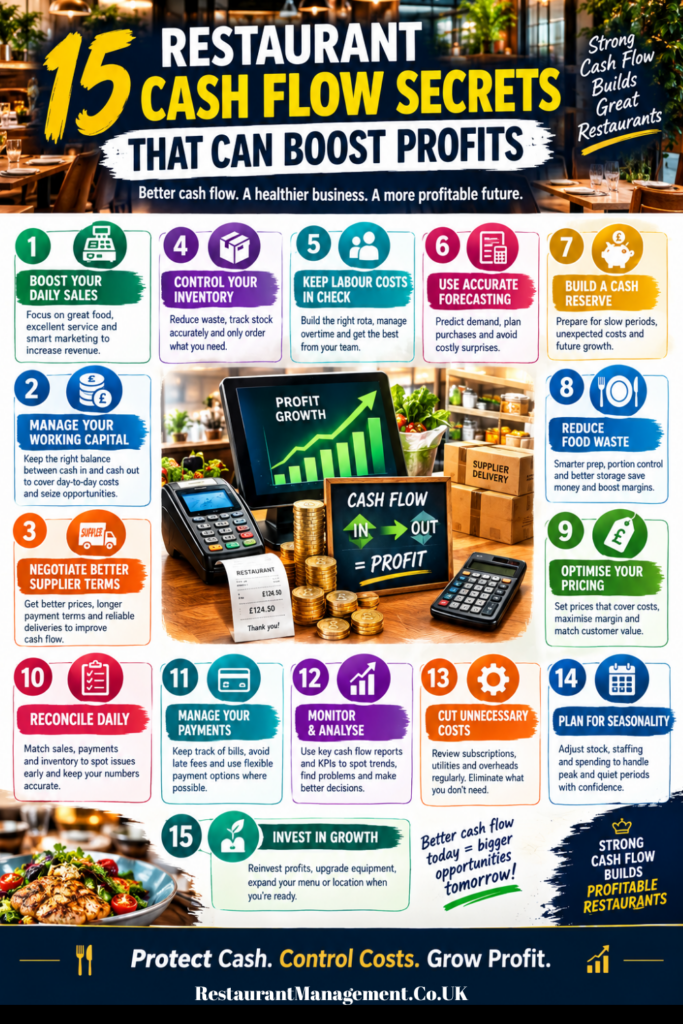
What Is Restaurant Cash Flow Management Secrets?
Restaurant cash flow management is the process of tracking, forecasting, and controlling the money entering and leaving a restaurant to ensure enough cash is available to pay bills and operate the business.
The concept has three basic parts.
Cash inflows
Cash can enter a restaurant through:
- Dine-in sales
- Takeaway orders
- Delivery
- Catering
- Private events
- Online orders
- Deposits
- Prepaid bookings
Cash outflows
Money leaves through:
- Payroll
- Food and beverage purchases
- Rent
- Utilities
- Insurance
- Business rates
- VAT and other taxes
- Loan repayments
- Repairs and maintenance
- Marketing
- Technology and software
- Owner drawings
The important point is that the timing of these transactions matters.
For example, a restaurant might generate £30,000 in sales in a month but face £12,000 in payroll, £7,000 in Supplier payments, rent, VAT, and a major equipment repair during the same period. The sales figure may look encouraging while the actual cash position is under severe pressure.

Why cash flow matters more than a busy dining room
A busy restaurant has revenue. It doesn’t necessarily have cash on hand.
Money may be tied up in inventory, held by payment processors, owed by customers, committed to upcoming Supplier invoices, or needed for tax obligations.
That is why experienced restaurant owners focus on how quickly they can turn cash into profit, not just how much they make in sales.
In the UK, we can see how fast a restaurant can go from doing well to struggling. A report from UHY Hacker Young in August 2026 showed that the top 100 restaurant groups in the UK made more money, with total sales rising from £12.9 billion to £13.3 billion. However, their profits dropped by 44% to just £204 million. This happened because costs for staff, taxes, food, energy, and other expenses rose and ate into profits.
The main takeaway is clear: making more money doesn’t always mean a restaurant is in a better financial situation.
Cash Flow vs Profit: What’s the Difference?
Cash flow and profit are connected, but they measure money in a business in different ways.
| Cash Flow | Profit |
| Tracks money moving into and out of the business | Measures revenue minus relevant expenses |
| Focuses on liquidity | Focuses on financial performance |
| Helps determine whether bills can be paid | Helps determine whether the business is economically profitable |
| Strongly affected by payment timing | Can include accounting adjustments and non-cash items |
| Can be negative while accounting profit is positive | Can be positive while available cash is low |
Can a profitable restaurant run out of cash?
Yes.
Imagine a restaurant records a profitable month but has several large payments due within a few days: Supplier invoices, payroll, VAT and a replacement refrigeration unit.
The restaurant may still be profitable on its accounts, but its bank balance could fall below what it needs to meet those commitments.
Profit keeps the business economically viable; cash flow keeps it operational.
That distinction should sit at the centre of restaurant financial management.
Master Cash Flow: The Proven Way to Maximise Business Profits
15 Restaurant Cash Flow Secrets
1. Create a Rolling Restaurant Cash Flow Forecast
A bank balance tells you what the restaurant has now. A cash-flow forecast tells you what it may have later.
A practical approach is to maintain a 13-week rolling cash flow forecast for the restaurant.
Track:
- Opening cash balance
- Expected sales
- Supplier payments
- Payroll
- Rent
- Utilities
- VAT and tax
- Loan repayments
- Major repairs
- Other significant expenses
- Forecast closing balance
Update the forecast every week.
The value comes from identifying a potential shortage while there is still time to respond.
For example:
Opening cash → expected inflows → planned outflows → closing cash
If week eight shows a projected £5,000 shortfall, management has time to investigate purchasing, payment timing, staffing, pricing, financing or other options.
Waiting until the bank account actually reaches £5,000 below expectations is not cash-flow management. It is crisis management.
2. Know Exactly Where Your Cash Is Going
You cannot control restaurant expenses you don’t understand.
Categorise cash outflows into meaningful groups such as:
- Labour
- Food
- Beverage
- Rent
- Utilities
- Marketing
- Repairs
- Finance
- Taxes
- Software
- Delivery fees
- Owner withdrawals
Then compare actual spending with your restaurant budget.
The goal isn’t to eliminate every expense. It is to distinguish between necessary expenditure, productive expenditure and avoidable leakage.
One useful monthly question is: Where did the cash go that we did not expect to spend?
Those unexpected categories often reveal the biggest opportunities for better restaurant cash management.
3. Control Restaurant Food Costs
Food purchasing is one of the clearest links between operations and cash flow.
Every pound sitting in unused ingredients is money that has already left the bank account.
Monitor:
- Purchasing
- Portion sizes
- Waste
- Spoilage
- Stock rotation
- Supplier prices
- Recipe costs
- Menu pricing
- Inventory levels
The basic food-cost formula is:
Food Cost % = Food Cost ÷ Food Sales × 100
Suppose a restaurant spends £9,000 on food to generate £30,000 of food sales.
Its food cost percentage is:
£9,000 ÷ £30,000 × 100 = 30%
But the percentage alone does not tell the whole story. Management should also investigate whether the cost is rising because of Supplier prices, waste, portion control, theft, menu mix or inaccurate recipe costing.
A small improvement repeated every week can release meaningful cash over a year.

4. Manage Labour Costs Around Sales
The answer to high labour costs is not automatically “cut staff.”
The better approach is sales-based labour scheduling.
Use:
- Historical sales patterns
- Forecast covers
- Day-of-week performance
- Expected bookings
- Peak trading periods
- Overtime data
- Employee productivity
- Cross-training
For example, scheduling the same number of employees on a historically quiet Tuesday as a busy Saturday can create unnecessary labour expenditure.
The objective is not to have the fewest employees possible.
The objective is to have the right number of employees for the level of business you expect.
That distinction matters because understaffing can damage service, increase errors and reduce sales, just as excessive staffing damages cash flow.
5. Negotiate Better Supplier Payment Terms
Supplier payment terms directly affect restaurant working capital.
Consider the difference between:
- Payment immediately
- 7-day terms
- 14-day terms
- 30-day terms
If a supplier relationship allows payment 30 days after delivery rather than immediately, the restaurant retains its cash for longer.
That can provide valuable breathing room.
Discuss:
- Payment dates
- Credit terms
- Order frequency
- Consolidated deliveries
- Minimum order quantities
- Early-payment discounts
- Upfront deposits
However, there is an important distinction:
Longer payment terms can improve short-term cash flow, but they do not make purchases cheaper.
Never use extended supplier credit to hide an underlying profitability problem.
6. Review Your Menu for Cash and Profitability
Menu engineering is not only a sales strategy. It can also support cash generation.
Analyse each dish according to:
- Selling price
- Ingredient cost
- Gross profit contribution
- Sales volume
- Preparation time
- Waste
- Customer demand
The classic menu-engineering framework categorises dishes as:
| Category | Typical characteristic |
| Stars | Popular and highly profitable |
| Plowhorses | Popular but less profitable |
| Puzzles | Profitable but less popular |
| Dogs | Low popularity and low profitability |
Stars deserve particular attention because they combine demand with strong contribution.
A dish that sells frequently and generates £8 contribution per sale may be more valuable for cash generation than a dish with a higher percentage margin but very low sales volume.
This is one reason restaurant profitability should be assessed in pounds contributed, not percentages alone.
7. Reduce Food Waste and Inventory Losses
Waste is cash leakage.
Common sources include:
- Over-ordering
- Spoilage
- Poor storage
- Incorrect stock rotation
- Oversized portions
- Preparation waste
- Theft
- Damaged products
- Unused ingredients
Practical controls include:
- Regular stock counts
- Par levels
- First-in, first-out rotation
- Waste logs
- Portion controls
- Variance analysis
- Supplier delivery checks
A waste log becomes particularly useful when it identifies recurring patterns.
If you throw away £150 of a particular ingredient every week, that is about £7,800 in annual purchasing that isn’t generating sales.
The solution may be a smaller order, a menu change, a different storage method or a recipe adjustment.
8. Keep a Close Eye on Daily Sales
Do not wait for the monthly P&L to discover that sales are underperforming.
Track daily:
- Total sales
- Covers
- Average spend per customer
- Food sales
- Beverage sales
- Delivery sales
- Discounts
- Refunds
- Voids
Then compare actual sales with forecast sales.
If the restaurant expected £7,000 in weekly sales but generates £5,800, the cash-flow forecast should change immediately.
This creates an early-warning system.
A forecast is only useful when management updates its assumptions as reality changes.
9. Build a Cash Reserve for Slow Periods
Not every cash surplus should be treated as available profit.
Restaurants can face:
- Seasonal downturns
- Equipment breakdowns
- Unexpected repairs
- Tax bills
- Supplier price increases
- Temporary sales declines
- Major maintenance
The ideal cash reserve varies by restaurant. No universal number of months works for every operator.
A seasonal destination restaurant, a small café, and a high-volume city-centre restaurant can have very different cash requirements.
The key is to determine how much cash is required to cover known fixed commitments and plausible short-term shocks.
That is working capital doing its job.

10. Separate Business and Personal Spending
Mixing personal and restaurant finances makes cash-flow analysis unnecessarily difficult.
Keep clear records of:
- Owner drawings
- Business expenses
- Personal purchases
- Business credit-card spending
- Expense reimbursements
- Management expenses
An owner should be able to look at the business bank account and answer:
How much money does the restaurant genuinely have available for its operations?
If personal spending and unexplained withdrawals are mixed into the account, that question becomes much harder to answer.
Clear separation also makes bookkeeping, budgeting and financial reporting more reliable.
11. Track Your Break-Even Point
Break-even analysis helps answer an important question:
How much does the restaurant need to sell to pay all its costs?
You can use a simple formula:
Break-even sales = Fixed Costs ÷ Contribution Margin
For example, if the restaurant’s fixed costs each month are £18,000 and its contribution margin is 60%, you would calculate it like this:
£18,000 ÷ 0.60 = £30,000
This means the restaurant needs to make about £30,000 in sales each month just to cover its costs, assuming that fixed costs and sales stay the same.
Break-even analysis is especially helpful when looking at changes, like if sales go up or down, if costs change, or if fixed expenses change. These factors can affect how much the restaurant needs to sell to break even are:
- Pricing
- Labour
- Rent
- Menu mix
- Opening hours
- Delivery commissions
- Sales targets
It converts a vague question — “Are we selling enough?” — into a measurable financial target.
12. Manage Tax and VAT Cash Flow
UK restaurants must treat tax obligations as planned cash commitments, not spare money sitting in the bank.
Depending on the business structure and circumstances, obligations can include:
- VAT
- PAYE
- National Insurance
- Corporation Tax
- Business rates
The standard VAT rate is currently 20%. To help restaurant owners feel confident, it’s important to recognise that HMRC requires restaurants to apply VAT to food and beverages consumed on-site, and that hot Takeaway food and home deliveries usually have VAT added to their prices.
How VAT Applies to Takeaways and Deliveries
- Hot Food: Any food that is warmed up for eating, kept warm, made fresh when you order it, or sold in containers that keep it warm is charged a 20% tax.
- Home Deliveries: Delivering hot takeaway food is subject to the 20% VAT rate, while delivering cold, zero-rated food items generally does not incur VAT on the food component.
- Cold Takeaway Food: Cold items like basic sandwiches or cold groceries to take away are usually zero-rated (0% VAT), unless they are consumed in a designated eating area.
- Exemptions and Exceptions: Items like crisps, confectionery, ice cream, and hot or cold soft drinks are standard-rated (20%) regardless of whether they are takeaway or eat-in.
Corporation Tax
For businesses, the Corporation Tax rates are as follows: if a company makes £50,000 or less in profit, it pays a tax rate of 19%. If profit is more than £250,000, the tax rate rises to 25%. Knowing these amounts is important for business managers, as it helps them plan their taxes better. A company may also pay a lower tax rate if its profits fall between those two amounts.
If a company makes profits between £50,001 and £250,000, a system called Marginal Relief helps. Instead of a big jump in tax, it lets the rate increase gradually. This means the tax rate starts at 19% and rises to 25% as profits increase.
The full breakdown of UK Corporation Tax bands works as follows:
As of Tax year – 2026/27 |
Key Rules to Keep in Mind
- If you own more than one company that is connected, the money limits of £50,000 and £250,000 will be split between those companies. For example, if you have two companies that are linked, the lower tax rate of 19% only applies to the first £25,000 for each company.
- Accounting Periods: If your company’s accounting period is shorter than 12 months, these profit limits are proportionately reduced.
You can check your exact liability using the official GOV.UK Marginal Relief Calculator.
Restaurant owners should regularly check the latest information from HMRC about tax rules and limits. Talk to your accountant and tax advisor. They can help you understand your taxes better and feel more confident about handling your tax duties. You can also Check current VAT guidance on GOV.UK
The practical lesson is simple: set money aside regularly for known tax liabilities rather than spending it and hoping the next few weeks will be strong enough to replace it.
13. Avoid Tying Too Much Cash Up in Stock
Inventory is like money that is stored in the restaurant.
| Too little stock creates: Stockouts → lost sales → unhappy customers.
Too much stock creates: Excess cash tied up → spoilage → waste → lower liquidity. |
The goal is to keep the right amount of products in stock so you can sell well without too much extra inventory.
Monitor:
- Par levels
- Stock turnover
- Supplier lead times
- Order frequency
- Minimum order quantities
- Inventory value
- Slow-moving products
Inventory management should therefore be viewed as a cash-flow discipline, not simply a kitchen procedure.
14. Review Restaurant Expenses Every Month
A monthly expense audit can uncover surprisingly easy savings.
Review:
- Software subscriptions
- Delivery fees
- Insurance
- Utilities
- Merchant fees
- Equipment leases
- Telephone contracts
- Marketing
- Cleaning contracts
- Maintenance agreements
Ask:
Would we sign up for this expense today?
If not, investigate it.
Do not automatically cut the cheapest expense. Look for expenses that provide little value relative to their cost.
A £100 monthly software subscription that saves £500 of labour may be worth keeping. A £100 subscription nobody uses is different.
Good restaurant cost control is about value, not indiscriminate cutting.
15. Use a Weekly Cash-Flow Review
Cash flow should become part of the restaurant’s operating rhythm.
Every week, review:
- Opening bank balance
- Sales received
- Outstanding supplier invoices
- Upcoming payroll
- Tax obligations
- Rent and utilities
- Expected sales
- Unexpected expenses
- Forecast closing balance
- Cash available for the following week
This creates a repeatable restaurant cash-flow management system.
Instead of asking at the end of the month, “Where did all the money go?”, management starts each week knowing what is coming.
Restaurant Cash Flow Management Example
Consider a hypothetical UK restaurant generating £30,000 in monthly sales.
Suppose its approximate monthly cash requirements include:
| Cash requirement | Example |
| Food and beverage purchases | £8,000 |
| Labour | £10,000 |
| Rent | £3,000 |
| Utilities | £1,000 |
| Other operating expenses | £3,000 |
| Tax/VAT provision | £2,000 |
| Total | £27,000 |
| Total Monthly Sales | £30,000 |
| Total Net revenue After Expenses | £3,000 |
At first glance, the restaurant appears to have £3,000 left.
But timing changes the picture.
Imagine £6,000 of Supplier invoices, £5,000 of payroll, and £2,000 of VAT all becoming payable in the same week.
The restaurant may have enough money over the month but not enough when those payments are due.
That is a cash-flow problem.
Better Supplier terms, tighter inventory purchasing, a weekly forecast and more disciplined cash reserves can reduce the risk without requiring the restaurant to generate thousands of pounds in additional sales suddenly.
The figures above are illustrative, not a recommended cost structure. Actual restaurant economics vary considerably by concept, location, menu, staffing model, rent and trading pattern.
Restaurant Management Guide – How To Best Manage A Successful Restaurant
The Most Important Restaurant Cash Flow Metrics to Track
| Metric | What it tells you |
| Cash balance | How much cash is currently available |
| Operating cash flow | Whether normal operations generate cash |
| Food cost % | How much food sales are consumed by food costs |
| Labour cost % | How much sales are being spent on labour |
| Prime cost | Combined food and labour costs |
| Gross profit | Revenue remaining after relevant direct costs |
| Break-even sales | Sales required to cover costs |
| Inventory turnover | How efficiently stock is being used |
| Accounts payable | Money owed to suppliers |
| Cash runway | How long available cash could support operations |
Do not monitor these metrics in isolation.
For example, a falling food-cost percentage may look positive, but if sales are also falling sharply, the restaurant may still be in a weaker financial position.
The best restaurant financial management connects sales, margins, costs and cash.
Common Restaurant Cash Flow Problems
Sales are strong but the bank account is empty. This usually indicates a disconnect between revenue and cash timing.
Investigate:
- Supplier payments
- Payroll
- Tax
- Inventory
- Debt repayments
- Capital expenditure
- Owner withdrawals
Supplier bills are arriving faster than expected.
Review how supplies are purchased and discuss appropriate payment terms. Also, look into whether the restaurant is ordering more often than necessary or holding too much inventory.
Payroll is consuming too much cash.
Look at labour in relation to sales, not labour in isolation.
Review schedules, overtime, staffing patterns and productivity.
Too much money is tied up in inventory.
Calculate how much stock is being held and identify slow-moving products.
Reduce excessive par levels where appropriate.
Unexpected expenses keep appearing.
Some unexpected expenses are unavoidable. The problem is when they repeatedly appear with no provision in the forecast.
A rolling cash-flow forecast and contingency reserve can make these events easier to absorb.
How to Improve Restaurant Cash Flow Quickly
In the next 24 hours
- Check the current bank balance.
- List all bills due in the next 30 days.
- Identify upcoming payroll and tax payments.
- Review Supplier balances.
- Identify any major unexpected payments.
In the next 7 days
- Complete a stock count.
- Review labour scheduling.
- Identify unnecessary expenses.
- Compare actual sales with forecast sales.
- Update the cash-flow forecast.
In the next 30 days
- Review Supplier payment terms.
- Analyse menu profitability.
- Review food and labour costs.
- Strengthen the cash reserve.
- Establish a weekly financial review.
- Revisit the restaurant budget.
This creates a useful progression:
Understand → Forecast → Control → Improve

How Cash Flow Management Improves Restaurant Profitability
Better cash flow management does not automatically make a restaurant profitable.
Instead, it gives management greater control over the resources required to become and remain profitable.
Effective cash management can help a restaurant:
- Reduce unnecessary borrowing
- Avoid late-payment problems
- Reduce waste
- Improve purchasing decisions
- Protect working capital
- Handle seasonal fluctuations
- Make better staffing decisions
- Invest in profitable opportunities
- Identify financial problems earlier
This matters particularly in a high-cost environment.
In 2025, UHY Hacker Young reported that the UK’s top 100 restaurant groups earned a total profit of £365 million. This demonstrates that strategic management can lead to success, even under significant cost pressures.
But its August 2026 update showed how quickly the picture can change: turnover increased again, while profits fell substantially as employment and operating costs increased. This should alert restaurant operators to the importance of monitoring financial health closely.
Restaurant Cash Flow Management Checklist
Weekly
☐ Check bank balance
☐ Compare actual sales with forecast
☐ Review upcoming payments
☐ Check labour costs
☐ Review food purchases
☐ Check waste
☐ Review supplier balances
☐ Update cash-flow forecast
Monthly
☐ Review P&L
☐ Analyse food cost
☐ Analyse labour cost
☐ Review supplier terms
☐ Review expenses
☐ Check tax obligations
☐ Review break-even position
☐ Review inventory value
☐ Assess cash reserve
Related articles:
Master Cash Flow: The Proven Way to Maximise Business Profits
Restaurant Cash Flow Management Secrets Every Owner Should Know
Restaurant Management Guide – How To Best Manage A Successful Restaurant
How To Be A Successful Restaurant Manager
Frequently Asked Questions About Restaurant Cash Flow
What is restaurant cash flow management secrets?
Restaurant cash flow management secrets is the process of monitoring, forecasting, and controlling the money entering and leaving a restaurant so enough cash remains available to pay operating expenses and financial obligations.
Why is cash flow important in a restaurant?
Cash flow is important because restaurants must continually pay wages, suppliers, rent, utilities, taxes and other expenses. Strong sales do not guarantee that enough cash will be available when those payments become due.
What is a good cash-flow position for a restaurant?
No universal cash balance or percentage represents a “good” position for every restaurant. The appropriate level depends on fixed costs, seasonality, Supplier terms, financing, business model and the restaurant’s ability to generate cash consistently.
How can a restaurant improve cash flow?
Start by forecasting cash flow weekly. Watch food and labour costs, and try to cut waste. Check your inventory regularly, negotiate better deals with suppliers, manage your taxes well, and cut any unnecessary expenses.
How many months of cash should a restaurant have?
No single figure suits every restaurant. The required reserve depends on the restaurant’s fixed commitments, seasonal volatility, access to finance, operating model and the reliability of its cash inflows.
Why can a profitable restaurant have poor cash flow?
Profit and cash flow use different financial concepts. A restaurant can report accounting profit while cash is tied up in inventory, committed to Supplier payments, absorbed by debt repayments or required for large expenses.
How do food costs affect restaurant cash flow?
When a restaurant buys food, it uses cash to get supplies. If the restaurant buys too much food, wastes a lot, or has ingredients that don’t sell quickly, it can use too much cash without making more money from sales.
How do labour costs affect cash flow?
Labour usually means regular cash costs that a business has to pay. If a company has more workers than it needs based on sales, it can end up spending too much on salaries and extra hours. This extra spending can make it hard to pay for other important expenses.
What is a restaurant cash-flow forecast?
A restaurant cash-flow forecast estimates future cash inflows and outflows over a defined period. A rolling 13-week forecast is particularly useful because it provides a forward-looking view while allowing you to update assumptions regularly.
How often should a restaurant review cash flow?
Ideally, review cash flow at least weekly. More frequent monitoring may be appropriate when cash reserves are tight, trading is volatile or significant payments are approaching.
What is the difference between restaurant cash flow and profit?
Restaurant profit measures financial performance after accounting for relevant revenues and expenses. Cash flow looks at how cash comes in and goes out of the business. A restaurant can therefore be profitable but temporarily short of cash.
Key Insights
The biggest mistake is treating restaurant cash flow as a month-end accounting exercise. It is an operational management system.
In an industry where margins can be squeezed by wages, energy, food prices, business rates and other operating costs, cash discipline becomes a competitive advantage. Recent UK restaurant data reinforces the point: even when the largest groups increase turnover, rising costs can rapidly erode the profit left behind.
The strongest restaurant operators understand:
- Cash flow and profit are different.
- Strong sales do not guarantee a healthy bank balance.
- A rolling cash-flow forecast provides an early warning system.
- Food and labour costs require constant attention.
- Inventory is money tied up in the business.
- How you pay your suppliers affects your available cash.
- You need to plan for taxes you owe.
- Keep extra money for unexpected costs.
- Checking your finances every week is better than finding out problems at the end of the month.
- The objective is not simply to sell more; it is to turn sales into usable cash efficiently and consistently.
The restaurant that knows its numbers has more options when conditions change.
And the restaurant that knows where its cash will be three, six or twelve weeks from now is in a much stronger position than one that checks today’s bank balance.
If you are building a more profitable restaurant, cash flow should sit alongside food cost, labour cost, prime cost, budgeting, inventory and menu engineering as part of the same financial management system.
Restaurant Cash Flow Management Secrets Every Owner Should Know