


High-profit Restaurant And Hospitality Menu Items
The most profitable restaurant or hospitality menu item is not necessarily the one with the cheapest ingredients. A £4 cocktail with a very high gross margin can contribute less cash to the business than a £18 main course with a lower percentage margin. Similarly, a dish that looks profitable on paper can become much less attractive once you factor in preparation time, waste, discounting, and portion inconsistency.
For UK independent restaurants and hospitality venues, the better question is not which is the top 10 high-margin restaurant & hospitality menu items. It is which menu items generate the strongest contribution after ingredient costs while using relatively little labour, creating little waste and selling consistently?
That is the thinking behind the following list.
Key Takeaways
- Spirits, cocktails, soft drinks, coffee and wine can produce particularly strong gross margins, but actual results depend on purchase prices, selling prices, portion control and wastage.
- Simple food can also be highly profitable when ingredients are inexpensive, portions are controlled, and preparation is efficient.
- Gross margin is different from net profit. Rent, wages, utilities, rates, card fees and other operating costs still have to be paid.
- A high-margin item that takes five minutes of skilled kitchen labour may be less attractive than a slightly lower-margin item that takes 30 seconds.
- Contribution margin is often more useful for menu decisions than food cost percentage alone.
- UKHospitality’s benchmarking survey demonstrates that margins vary considerably by hospitality segment rather than following one universal target. Its 2022 survey reported food gross margins ranging from 65.9% to 69% across several segments and wet-sales margins from 64% to 72.7%.
- The best way to identify your own most profitable products is to combine recipe costing, selling price, sales volume, labour and waste data.
What Makes a Restaurant or Hospitality Menu Item Highly Profitable?
A profitable menu item usually has several characteristics working together.
1. Low ingredient cost
The first consideration is the cost of the ingredients required to produce one sale.
For a £12 dish costing £3 in ingredients:
Food cost percentage = £3 ÷ £12 × 100 = 25%
That leaves £9 before other costs.
But that £9 is not £9 of net profit. It must cover labour, rent, utilities, insurance, business rates, technology, cleaning, marketing, and other operating costs.
Recipe costing therefore needs to be accurate. Small amounts matter: a sauce, garnish, cooking oil, bread, condiments or complimentary side can turn an apparently low-cost dish into a considerably more expensive one.
2. A selling price customers accept
Low ingredient cost creates an opportunity. Customers still have to perceive sufficient value to pay the menu price.
That is why menu descriptions, presentation, portion size, location, concept and customer expectations influence profitability.
A £2 ingredient cost does not automatically justify a £15 selling price.
3. Low labour requirement
Labour is particularly important in the UK because staffing costs are substantial.
From April 2026, the National Living Wage for workers aged 21 and over is £12.71 per hour.
Consequently, two dishes with identical ingredient costs can have very different economics.
One might require:
- 30 seconds of finishing time
- one standard portion
- little supervision
while another requires:
- five minutes of preparation
- multiple cooking stages
- skilled chef input
- several garnishes
- additional washing-up
The recipe cost may be identical. The operational cost is not.
4. Low waste
Waste reduces the revenue each purchased ingredient generates.
Strong menu design therefore considers:
- shelf life
- portion control
- preparation waste
- spoilage
- overproduction
- incorrect orders
- cross-utilisation of ingredients
An ingredient used across several dishes can be commercially attractive because purchasing is easier and stock is more likely to be used before deterioration.
5. Strong sales volume
Margin percentage alone can be misleading.
A £10 item producing an £8 contribution has an 80% gross margin.
But selling 10 of them produces £80 of gross profit.
A £25 item producing a £15 contribution has a 60% gross margin.
Sell 30, and it produces £450 of gross profit.
That is why margin × volume is much more useful than margin percentage alone.

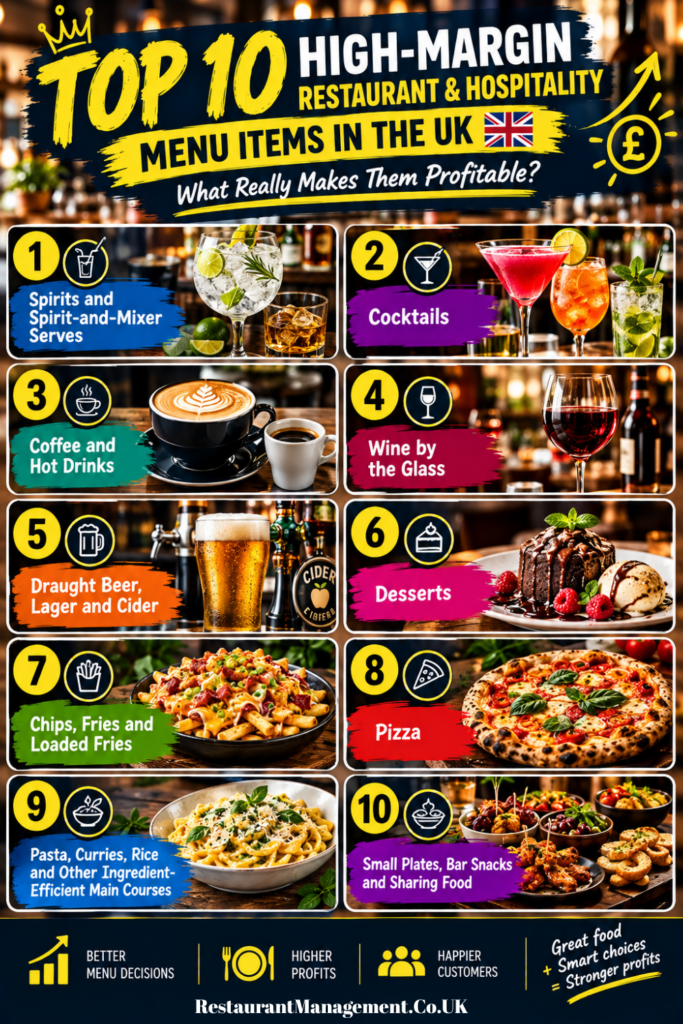
The Top 10 High-Margin Restaurant & Pub Items
These are not guaranteed to be the ten most profitable products in every UK venue. They are menu categories that can deliver strong margins when priced, portion-controlled, and operated efficiently.
1. Spirits and Spirit-and-Mixer Serves
Spirits can be exceptionally attractive from a gross-margin perspective because a relatively small measured quantity of product can generate a comparatively high selling price.
Examples include:
- Gin and tonic
- Vodka and mixer
- Whisky and mixer
- Rum and mixer
- Premium spirit serves
The commercial advantage is straightforward: the spirit itself represents only part of the selling price, while the customer also pays for service, venue, mixer, presentation, and experience.
The profitability trap
If drinks are not measured correctly, it can hurt the business’s profits. For example, if a bar is supposed to serve a 25ml drink, but the staff are pouring 30 to 35ml instead, the bar is giving away extra drinks without making more money.
This means:
- careful pouring of drinks
- buttons on the cash register that are easy to use
- counting the stock often
- using the right types of glasses
- following the recipe correctly
- keeping an eye on profit margins
2. Cocktails
Cocktails can combine relatively modest ingredient costs with a premium price. A well-designed house cocktail usually has:
- A specific amount of a strong drink, like whiskey or vodka
- An inexpensive soft drink to mix with it
- A sweet syrup for added flavour
- Citrus fruits, like lemons or limes
- A decorative touch (garnish)
- Ice
The potential margin can therefore be strong. As a result, you can make a good profit.
However, cocktails demonstrate why gross margin is not the same as profitability.
A cocktail that takes three minutes to prepare during a busy Saturday service can consume substantially more labour than a straightforward spirit-and-mixer serve.
Fresh fruit, herbs and garnishes also introduce waste.
Improve the economics
Standardise:
- recipe
- pour
- glass
- garnish
- preparation method
- selling price
Then measure preparation time and ingredient cost.
3. Coffee and Hot Drinks
Coffee can be an attractive menu category because its main ingredients can represent a relatively small share of the selling price.
The economics become particularly interesting when coffee is:
- served quickly
- produced consistently
- sold throughout the day
- attached to breakfast or lunch
- offered alongside dessert
- available for takeaway
Coffee also creates an opportunity to increase the value of an existing customer visit. A customer who has already purchased lunch may add a coffee with relatively little additional selling effort.
Watch the hidden costs.
The true economics include:
- beans
- milk
- syrups
- takeaway cups and lids
- wastage
- machine maintenance
- cleaning
- barista labour
- equipment depreciation
The principle is therefore not simply “coffee is cheap to make.”
It is: Coffee can generate strong contributions when production is fast, consistent and supported by sufficient volume.
4. Wine by the Glass
Selling wine by the glass can help restaurants and bars make more money per bottle than selling wine by the bottle. Take a bottle of wine that costs £30 and contains about 750ml; it can be served in five 150ml glasses. This way, restaurants can earn more while giving customers different options.
£30 ÷ 5 = £6 cost per glass
If each glass sells for £10:
Revenue = £50
Gross profit before other costs = £50 − £30 = £20
Gross margin = £20 ÷ £50 × 100 = 40%
This example deliberately shows why operators should calculate the numbers rather than assume that a product is automatically high-margin.
Change the purchase price, glass size or selling price, and the result changes immediately.
Perform the same calculation for every wine range.
This example shows that restaurant managers should do the math to understand how much money they can really make, instead of assuming that selling a product will always bring in a lot of profit.
Change the purchase price, glass size or selling price, and the result changes immediately.
Perform the same calculation for every wine range.
Control the variables
Monitor:
- standard pour size
- bottle yield
- wastage
- open-bottle deterioration
- complimentary drinks
- staff drinks
- discounts
A wine that seems great on a menu or cost sheet might not sell well at the cash register. This shows that restaurant operators need to pay attention and be flexible. A wine that looks excellent on a theoretical menu-costing sheet can perform very differently at the till.
Restaurant Food Cost Percentage Formula: How to Calculate and Increase Profits
5. Draught Beer, Lager and Cider
Beer remains central to pub economics because it combines repeat demand with relatively straightforward service.
The commercial equation includes:
Selling price − product cost − wastage = gross contribution
But operators must account for:
- correct pint measures
- line cleaning
- cellar losses
- spillage
- overpouring
- temperature
- product deterioration
- discounts
Offering higher-quality products can help raise the selling price. However, these quality products will only make more money if customers are willing to pay the higher price.
UKHospitality’s benchmarking survey found substantial variation in wet-sales gross margins between hospitality segments, ranging from 64% in accommodation-led businesses to 72.7% in nightclubs in its 2022 survey. That is useful evidence against treating one “standard” drinks margin as universal.
6. Desserts
Desserts are often overlooked when operators focus on main-course profitability.
Products such as:
- brownies
- cheesecake
- sticky toffee pudding
- ice cream
- Eton mess
- chocolate desserts
can work particularly well when they are batch-produced and portion-controlled.
The commercial advantage is that much of the preparation can occur before service.
A dessert can also increase the value of an existing table rather than requiring a completely new customer.
For example:
Main course + drink = £25
Add:
Dessert + coffee = £9
The second transaction may require considerably less selling effort than acquiring another customer.
The opportunity
Design desserts around:
- controlled portions
- limited ingredients
- shared components
- low finishing time
- attractive presentation
- profitable add-ons
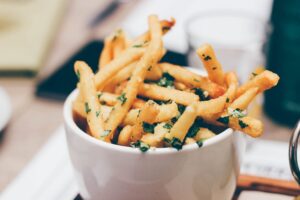
7. Chips, Fries and Loaded Fries
Potatoes are relatively inexpensive compared with many protein ingredients, making fries an obvious candidate for strong margins.
But cheap ingredients do not guarantee profitability.
The operator still has to control:
- portion weight
- oil consumption
- cooking losses
- sauces
- toppings
- packaging
- labour
- delivery quality
Loaded fries can sell for a higher price because of the toppings and sauces added, but you need to know the cost of each addition. Instead of asking, “How cheap are the potatoes?” ask, “How much money do we make from each portion after considering the time and fryer space we use?”
8. Pizza
Pizza is appealing because its main ingredients don’t cost much, but people feel they get great value when they buy it.
A basic pizza may combine:
- dough
- tomato sauce
- cheese
- selected toppings
The economics improve when ingredients are cross-utilised across the menu.
For example, the same tomato sauce might be used in:
- pizza
- pasta
- lasagne
- dipping sauces
That reduces menu complexity and helps stock move through the kitchen.
Pizza can also benefit from a production system designed around throughput.
The key distinction is that pizza can have strong contribution margins; it is not inherently profitable regardless of how the kitchen is operated.
9. Pasta, Curries, Rice and Other Ingredient-Efficient Main Courses
Simple dishes that use fewer ingredients should get more recognition than they usually do.
Examples include:
- pasta dishes
- curries
- rice bowls
- noodle dishes
- vegetarian mains
- grain-based dishes
Staple ingredients can have relatively low unit costs, while sauces, spices, vegetables and controlled quantities of protein create opportunities for differentiation.
Protein is often the major variable.
A pasta dish with a £1.50 base can become a completely different commercial proposition when you add £6 of premium protein.
That makes menu architecture important.
Rather than simply asking: “What is the food cost percentage?”
ask:
“What contribution does the additional protein generate?”
If adding £3 of chicken allows a £7 increase in selling price, the upgrade may create useful incremental contributions.
10. Small Plates, Bar Snacks and Sharing Food
Small plates can contribute significantly while also increasing customer spend.
Examples include:
- garlic bread
- olives
- dips
- wings
- croquettes
- arancini
- nachos
- onion rings
- nuts
The selling price of an individual item may be modest, but the preparation can be efficient.
They can also complement drinks particularly well. This creates an important commercial relationship:
More drink occasions → more food attachment opportunities → higher average spend
The operator should therefore analyse the item not just as an individual product but as part of the customer’s overall basket.
Restaurant and Hospitality Profit Margin Comparison
The following table is a qualitative operational comparison, not a set of universal UK margin benchmarks.
| Item | Ingredient cost potential | Selling-price potential | Labour | Waste risk | Volume potential |
| Spirits | Low | High | Low | Low–Medium | High |
| Cocktails | Low–Medium | High | Medium | Medium | Medium–High |
| Coffee | Low | Medium | Low–Medium | Low–Medium | High |
| Wine by glass | Medium | Medium–High | Low | Medium | High |
| Draught beer | Medium | Medium–High | Low | Low–Medium | High |
| Desserts | Low–Medium | Medium | Low–Medium | Medium | Medium |
| Fries/loaded fries | Low–Medium | Medium | Low–Medium | Medium | High |
| Pizza | Low–Medium | Medium–High | Medium | Low–Medium | High |
| Pasta/curries | Low–Medium | Medium | Medium | Low–Medium | High |
| Small plates/snacks | Low–Medium | Medium | Low–Medium | Low–Medium | Medium–High |
UKHospitality’s published benchmarking reminds us that actual gross margins vary by business model. In its 2022 survey, the overall figures were 66% for wet sales and 67% for food sales, with different market segments producing different results.
Why the Highest-Margin Item Isn’t Always the Most Profitable
This is one of the most important distinctions in menu engineering.
Consider two products.
Item A
- Selling price: £10
- Variable cost: £2
- Contribution: £8
- Gross margin: 80%
Item B
- Selling price: £25
- Variable cost: £8
- Contribution: £17
- Gross margin: 68%
Item A has the higher percentage margin.
But Item B generates more gross profit per sale.
Now introduce volume.
If you sell:
100 × Item A = £800 contribution
but:
100 × Item B = £1,700 contribution
When looking at costs, consider how much time workers spend preparing food. If Item B takes much longer to make, it changes how we view costs and benefits. Here are some key points to consider:
– Contribution Margin: This is the amount you make after covering the costs. You find this by subtracting the costs from the selling price.
Also, it can help to look at:
– Contribution per Labour Minute: This tells you how much money you make for every minute spent making or serving the food. You get this by dividing the Contribution Margin by the total time spent.
This last measure is especially useful when there isn’t enough space or equipment for everyone in the kitchen.
Master Cash Flow: The Proven Way to Maximise Business Profits
How to Find Your Own Most Profitable Menu Items
Step 1: Cost every recipe
Include:
- every ingredient
- garnish
- sauce
- cooking oil
- bread
- toppings
- packaging where applicable
Do not rely on memory or Supplier list prices from months ago.
Recipe-level technology can now link ingredients to menu items and automatically calculate COGS and margins. For example, Square’s UK recipe-costing functionality connects recipes to ingredient costs and reports item-level COGS, revenue, profit and margin.
Step 2: Calculate gross margin
Use:
Gross Margin % = (Selling Price − COGS) ÷ Selling Price × 100
For example:
£15 selling price
£4 COGS
Gross margin = (£15 − £4) ÷ £15 × 100 = 73.3%
Remember that this is gross margin, not net profit.
Step 3: Calculate contribution margin
Contribution margin looks beyond percentage and asks:
How many pounds does this sale contribute towards the restaurant’s fixed and operating costs?
For a £15 item costing £4 in variable costs:
Contribution = £11
That £11 can then help pay wages, rent, utilities and other overheads.
Step 4: Add sales volume
A high-margin product that sells twice a week may be less commercially important than a lower-margin product selling 300 times.
Analyse:
- units sold
- revenue
- gross profit
- gross margin
- contribution
- sales mix
Step 5: Add labour and waste
This is where basic menu costing becomes genuine menu profitability analysis.
Measure:
- preparation time
- cooking time
- finishing time
- wastage
- remakes
- portion variance
- stock losses
The result is a much clearer picture of which products deserve more menu space and management attention.

Use Menu Engineering to Increase Profit
A classic menu-engineering framework categorises products by popularity and profitability.
Stars
High popularity + high profitability
Protect availability, promote them and make consistency a priority.
Plough Horses
High popularity + lower profitability
These sell well, so removing them may damage revenue. Instead, examine:
- portion size
- recipe cost
- price
- supplier pricing
- add-ons
- preparation efficiency
Puzzles
Low popularity + high profitability
The economics may be good, but customers are not choosing the item.
Investigate:
- menu description
- placement
- presentation
- perceived value
- staff recommendations
Dogs
Low popularity + low profitability
These deserve scrutiny.
Sometimes the answer is reformulation. Sometimes it’s removal.
The key is not to remove products simply because their margin percentage looks poor. Consider their role in the overall menu and customer experience.
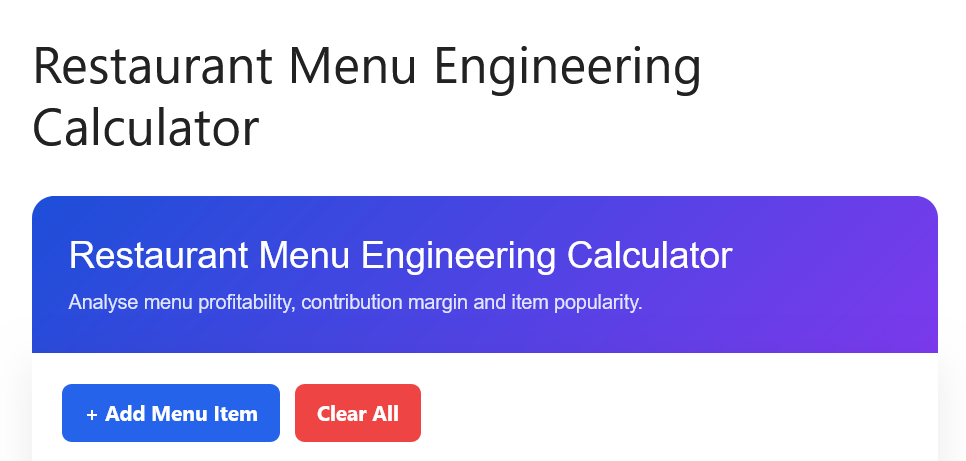
Use our Restaurant Menu Engineering Calculator to analyse item popularity and profitability, identify your best and worst performers, and make smarter menu decisions.
7 Ways to Increase Profit from High-Margin Items
1. Improve menu descriptions
Customers buy perceived value, not ingredient cost.
A well-described product can communicate:
- provenance
- preparation
- flavour
- quality
- occasion
without misleading the customer.
2. Build profitable add-ons
Examples include:
- extra cheese
- sauces
- premium toppings
- sides
- desserts
- coffee
- premium spirits
Every add-on should have its own recipe cost.
3. Create food-and-drink combinations
A high-margin drink can complement a food item, but avoid discounting so aggressively that the promotion destroys the contribution you were trying to create.
4. Control portions
Weighing and standardising portions can deliver greater financial benefits than repeatedly negotiating small Supplier discounts.
A 20g over-portion may seem insignificant.
Multiply it by thousands of covers, and it becomes a purchasing problem.
5. Cross-utilise ingredients
Use compatible ingredients across several dishes without making the menu unnecessarily complicated.
This can reduce:
- waste
- stockholding
- purchasing complexity
- training requirements
6. Reduce preparation time
Look for dishes that can be:
- batch-prepared
- pre-portioned
- finished quickly
- produced consistently
Consider labour productivity alongside food cost.
7. Re-cost regularly
Supplier prices change.
So do:
- portion sizes
- recipes
- selling prices
- VAT treatment
- promotional discounts
A recipe cost from six months ago may no longer represent today’s economics.
Restaurant Budgeting: How to Build a Profitable Financial Plan
Common Mistakes That Destroy High Menu Margins
Even a theoretically excellent product can become unprofitable through poor execution.
Over-portioning
Giving customers more product than the recipe specifies reduces the margin on every sale.
Unmeasured drinks
When bartenders pour drinks without measuring, it’s hard to know how much profit we really make.
Too many garnishes
If we use a lot of extras (like fruit or herbs) in drinks, the cost can add up quickly, especially when serving many customers.
Bad stock rotation
If we don’t use products in the right order, we might waste items or lose track of what we have.
Spoilage converts purchased stock directly into waste.
Ignoring Supplier price increases
A £10 dish can quietly become a £10 dish with a £3.50 recipe cost instead of £2.80.
Discounting automatically
A high-margin product doesn’t need a discount just because it has a high margin.
Excessive menu complexity
More dishes can mean more ingredients, more stockholding, more training and more waste.
Ignoring labour
A menu item can have an attractive food margin while consuming too much kitchen capacity.
Failing to update recipe costs
Technology can help, but only if ingredient unit costs remain accurate. Square, for example, explicitly notes that current ingredient unit costs are needed for accurate COGS and margin reporting.
Related article:
15 Restaurant Cash Flow Secrets That Can Boost Profits
How to Make Profit in Your Restaurant
The Top 10 Most Profitable Fast Food Franchises In The UK
Menu Engineering: How to Identify Your Most and Least Profitable Dishes
Master Cash Flow: The Proven Way to Maximise Business Profits
Frequently Asked Questions
What is the most profitable item to sell in a pub?
There is no single universally most profitable pub item. Spirits, cocktails, some wines, beer and other drinks can generate strong gross margins, but profitability depends on purchase price, selling price, portion control, wastage, labour and sales volume.
What food has the highest profit margin in a restaurant?
Foods that are easy to make and use few ingredients can have good profit margins. This includes some pasta dishes, pizzas, fries, desserts, and small plates. However, no single type of food always makes the most money because recipes and prices vary by restaurant.
What is a good food profit margin for a UK restaurant?
No single margin applies to every restaurant. Concept, location, service style, menu mix, Supplier pricing and labour model all matter.
Use benchmarking to spot unusual performance rather than unthinkingly copying another restaurant’s target.
What is the most profitable restaurant food?
The item that makes the most money for a restaurant usually has a good selling price, keeps ingredient costs low, is popular with customers, doesn’t require much staff to make, and creates little leftover food.
Are desserts profitable in restaurants?
They can be. Batch preparation, portion control and relatively simple finishing can make desserts attractive from a contribution perspective. Still, calculate their profitability using the restaurant’s actual recipe and labour data.
How do restaurants calculate profit margins on menu items?
The basic gross-margin calculation is:
Gross Margin % = (Selling Price − COGS) ÷ Selling Price × 100
For more useful menu analysis, operators should then add sales volume, labour, waste and other variable costs.
What is the difference between gross margin and contribution margin?
Gross margin shows how much money a restaurant makes from selling its products after subtracting the cost of making those products. It is expressed as a percentage of total sales.
Contribution margin measures how much money remains after specified variable costs to contribute towards fixed and operating costs. Neither figure is the same as net profit.
How often should a restaurant review menu profitability?
Review frequency should reflect the volatility of the operation. High-volume restaurants or venues with volatile ingredient prices may need much more frequent monitoring than a small operation with stable recipes.
At minimum, operators should re-cost recipes when significant Supplier prices, portion sizes or selling prices change.
Key Insights
- Do not confuse gross margin with net profit. A 75% gross margin does not mean the business keeps 75% of the selling price.
- Do not judge a menu item on ingredient cost alone. Labour, waste, volume and operational complexity can materially change the result.
- Contribution matters. A lower-margin £25 item may contribute more pounds per sale than a higher-margin £10 item.
- Drinks, desserts and ingredient-efficient dishes can be powerful profit contributors, but only when purchasing, portioning, pricing and execution are controlled.
- Your own menu data is more valuable than a generic “best profit margin” list. Cost your recipes, analyse sales, measure labour and track waste.
- Menu profitability is an operating system, not simply a pricing exercise. Purchasing, stock control, kitchen processes, staff training, menu design and customer behaviour all affect the final result.
One final UK consideration is VAT. Restaurant operators need to distinguish between VAT-inclusive selling prices and net revenue when analysing margins. HMRC states that restaurant meals and drinks consumed on the premises are standard-rated, as are alcoholic drinks and many other food and drink categories; specific rules also apply to takeaway food and other supplies.
The practical next step is simple: take your top 10–20 menu items, calculate their current recipe costs, selling prices, gross margins, contribution and sales volumes, then identify which products consume the most labour and generate the most waste. That analysis will tell you far more about your restaurant’s real profit opportunities than any generic list of “high-margin foods”.
Conclusion
The restaurant and hospitality menu items that make the most profit are not always the cheapest to buy or the most expensive on the menu. The best-selling items have strong profit margins, are popular with customers, require less effort from staff, have manageable portion sizes, and produce little leftover food.
Drinks such as spirits, cocktails, coffee and wine can generate strong gross margins, while well-designed food such as pizza, pasta, desserts, fries and small plates can also deliver excellent contribution when properly costed and managed.
The key is to stop judging menu profitability by food cost percentage alone. Calculate your gross margin, contribution per sale, sales volume, labour requirement and waste. Then use that information to refine pricing, recipes, menu placement and purchasing.
Ultimately, your restaurant’s most profitable items are revealed by your own numbers—not a generic industry ranking.
5 Proven Cash Flow Controls That Protect Your Restaurant Profits