

UK Restaurant Industry in 2026
The UK restaurant industry in 2026 is no longer simply “recovering.” It has entered a harder, more mature phase: customers are still eating out, but they are spending more carefully; operators are facing some of the highest cost pressures in years, and the businesses doing well are usually the ones that have made their offer clearer, their operations leaner, and their experience worth leaving the house for.
In other words, this is no longer a post-pandemic rebound story. It is a story about survival, reinvention, and finding growth in a market where demand exists—but margins are painfully thin.
Where the industry stands now
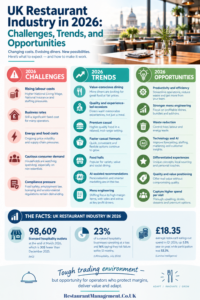
Restaurants, cafés, pubs, and food services are vital to the UK economy and society. Together, these businesses support around 2.6 million jobs. Many of them are small, independently owned places rather than big chain companies.
But the operating environment has become tougher. IGD forecasts UK away-from-home food and drink sales to reach £103.3 billion in 2026, rising to £123.8 billion by 2031. That sounds encouraging, but much of the growth is expected to come from higher prices rather than more customers or bigger orders.
That distinction matters. A restaurant can record higher sales and still be worse off if food, wages, rent, energy, and tax costs rise faster than covers.
The Cost Squeeze Is The Defining Issue
When you talk to restaurant owners in 2026, they usually don’t begin by discussing “new menu ideas.” Instead, they often start by talking about paying their workers, energy costs, taxes, and National Insurance.
The National Living Wage rose to £12.21 in April 2025 and increased again to £12.71 from April 2026. The 2026 business rates revaluation also took effect on 1 April, with pub and restaurant rateable values rising by an average of 30%, according to VOA data summarised by the House of Commons Library.
The Institute for Fiscal Studies has found that, due to changes in National Insurance and the minimum wage, the cost of hiring workers in places like hotels and restaurants will rise by about 7.7%. In comparison, the overall average cost increase in other industries is only 6.4%. This difference happens because the hospitality sector employs more young workers who often have less experience.
As a result, managing workers effectively has become very important for businesses in this industry. Instead of cutting jobs, successful companies are focusing on improving how they run their operations. This means changing work schedules, simplifying menus, training staff for multiple roles, and closely tracking how much money they make per labour hour.
Recent studies show an interesting trend: revenue has risen 10.25% compared to last year, while hours worked have fallen 3.42%. This means that for every hour worked, there is now more money being made, specifically a 14.16% increase in money earned per hour. These results suggest that people are working more effectively, and it may be helpful to look more closely at how work is organised and how workers are assigned tasks.
In 2026, our main goal is to work better and smarter. You want to get great results with your staff while providing excellent service to your guests. Guests need to feel their experience is personal, not rushed.
How Much Money Do You Really Need to Open a Restaurant in the UK?
Consumers Still Want To Eat Out—Just Differently
The good news is that people still go out. Eating out remains an affordable luxury for many households, especially when it is tied to an occasion, a social catch-up, or a specific experience.
Today, when people eat out, they want more than just low prices. Here are some things that are important to modern diners:
- Clear prices without hidden fees.
- Big portion sizes or a feeling that they are getting good value.
- Menus that look nice and modern, but are still easy to understand. They should avoid being too fancy or complicated.
- Good service is very important. If service is not good, people expect better, especially if they are paying more.
- There needs to be a good reason for choosing to eat at a restaurant instead of dining at home, getting food delivered, or cooking at home.
Younger diners and the returning 35–44 age group are helping support eating-out intentions, according to BDO’s 2026 restaurants and bars report. But operators cannot rely on broad consumer optimism alone. They need to give people a specific reason to visit.
Value-led Menus Are Winning
Menus that focus on good value are becoming very useful in restaurants. These menus help restaurants operate more efficiently and simplify operations. A simple, clear menu can reduce food waste, speed up training, help staff serve faster, and improve food quality. This strategy has worked well, especially for fast-casual restaurant brands.
For example, Tortilla, a restaurant chain, saw a big increase in UK sales in the first half of 2026—up 13.9%. Their delivery sales also grew sharply, up 32.7%, bringing total sales to £100.9 million over the past year. This shows how having a focused menu can help restaurants earn more money and run more smoothly.
Not every fast-casual restaurant is doing well. For example, Tortilla has closed some locations to focus on the best spots. This shows that even successful brands need to be careful about where they open. The key lesson is not to open more restaurants, but to choose the best places and give people a good reason to come in.
Delivery Is No Longer Optional—But It Must Be Profitable
Delivery remains important, but the naive “put everything on Deliveroo and hope for the best” approach no longer works. Commission fees, packaging, food quality in transit, and labour costs can turn a busy delivery channel into a margin trap.
Tortilla’s delivery growth shows that demand is still there. But successful operators now treat delivery as a separate profit centre, with its own menu engineering, packaging standards, preparation flow, and pricing.
Important points for restaurants to improve their delivery services are:
- Which food items stay good during delivery and still make a profit?
- Are delivery fees set correctly to cover costs from third-party delivery services?
- Does the packaging keep the food fresh and also make the brand look good?
- Do delivery orders change how much money the restaurant earns from customers eating inside?
- Can the kitchen take more delivery orders without making the service for dine-in customers slower?
A delivery-only restaurant idea can be successful, especially for trying out a new brand or using extra kitchen space. However, by 2026, it needs to make good financial sense—not just a catchy name and being listed on a delivery app.
Experience Is The New Competitive Advantage.
With so many alternatives, restaurants need to offer something a supermarket meal deal or a delivery app can’t replicate.
That does not necessarily mean expensive entertainment or elaborate theming. It can be as simple as:
- A friendly and warm place that makes your dining experience special.
- Staff who know the menu well and can suggest great dishes.
- A special dish that is unique and memorable, showing what makes the restaurant special.
- A delicious drink or dessert served beautifully that adds to the enjoyment of your meal.
- A restaurant that can easily adjust its setup for different dining occasions, whether it’s a cosy dinner for two, a family gathering, a quick lunch, or a grand celebration.
Christie & Co notes that demand for dining-out experiences is expected to remain, with the overall food-service market forecast to grow at a 6.6% CAGR to 2030. It also reports that around 20% of diners already say sustainability, health, and ethical values influence their choice of venue.
The opportunity is not to become everything to everyone. It is to become the obvious choice for one clear type of guest and occasion.
Sustainability Has Moved From Marketing To Operations.
Sustainability is no longer only about eco-branded packaging or a vegan option on the menu. In 2026, it is increasingly an operational issue tied to cost control.
Reducing food waste in restaurants is important. It helps the environment and saves money. When restaurants have good ways to manage waste, they can lower their ingredient costs which can lead to higher profits.
Here are some simple steps to help restaurants be more sustainable:
- Track Food Waste: Create a system to keep an eye on how much food is wasted. Review different menu items, times, and kitchen areas to identify where you can improve.
- Smart Preparation Sheets: Make preparation sheets based on what people actually eat, not on old habits. This helps use ingredients better and reduces waste.
- Combine Ingredients in Menus: Design menus that include the same ingredients in several dishes. This makes using ingredients more efficient and helps avoid extra leftovers.
- Buy Local and Seasonal Ingredients: Try to get ingredients from local farms or choose seasonal products. This can improve food quality and also save money.
- Review Sustainability Efforts: Be careful with sustainability plans that might cost too much without helping the dining experience. Make sure each action taken is needed and makes a difference.
The objective is to establish credible and quantifiable sustainability metrics rather than relying on ambiguous claims in marketing materials.
The Market Is Churning, Not Standing Still.
One of the most important 2026 trends is that the market looks stable on the surface but is changing rapidly underneath.
NIQ reports a 7% churn in hospitality sites over the last 12 months: 3,885 venues closed while 3,703 opened. That means the industry is not simply shrinking. It is being reshaped.
Weak concepts, poor locations, and unsustainable cost structures are closing. But entrepreneurs and operators are still taking on vacant sites, testing new ideas, and opening venues where they see local demand.
This creates opportunity for independent operators—provided they enter with realistic numbers. A vacant restaurant site is not automatically a bargain. Rent, rates, fit-out costs, staffing, and local competition still decide whether it becomes a business or another closure statistic.
Big-brand Restructuring Is Reshaping The High Street.
Large hospitality groups are also making difficult decisions. Whitbread closed all of its Beefeater and Brewers Fayre sites in September 2026, alongside other restaurant brands, bringing the total to 195 sites. The restructuring is part of a wider plan expected to affect around 3,800 roles, as the group focuses on Premier Inn growth and seeks £250 million in cost savings.
This situation matters because it shows that being a big restaurant isn’t enough to protect it from market problems. Even large restaurants face the same basic issues as smaller ones, like high labour costs, expensive rent, changing customer preferences, and making sure each location succeeds.
For smaller restaurants, this can be an advantage. They may have better chances to find great locations, more experienced workers returning to the industry, and less competition from big brands that are no longer popular in their areas.
Technology: Useful, Not Magical
Technology is still changing how restaurants work, but now the focus is on practical solutions. Restaurant owners care less about fancy ideas for the future and more about tools that can help them handle paperwork, reduce waste, and make better choices.
In 2026, the most useful ways to use technology include:
– Predicting how many customers will come in based on the day, weather, events, and seasons.
– Making staff schedules better and reducing the number of people working when it’s not needed.
– Counting how many ingredients are used and how much is wasted.
– Handling online reviews and customer comments better.
– Simplifying the process for reservations, waitlists, and table assignments.
– Finding out which menu items make the most profit, not just the most sales.
Artificial Intelligence (AI) can help restaurants track what they sell and manage supplies. But it won’t solve problems like confusing menus, untrained employees, weak leadership, or a bad business plan. The best businesses use technology to help them manage well, instead of depending on it completely.
Key Focus Areas for Restaurants in 2026
For restaurant owners and managers, it’s important to work well and keep customers happy. Here are some important points to think about:
1. Understand Your Costs
Know how much you spend on food, staff, delivery, and other costs for each menu item. Analysing how much money each dish makes can help you avoid losing money.
2. Simplify Your Menu
A shorter, more focused menu can help everything run more smoothly. It helps serve food faster, keeps quality consistent, reduces waste, and makes it easier to train staff. Plus, you can better promote high-profit items.
3. Create a Great Guest Experience
Ensuring customers have a great experience is essential. Good service, a nice atmosphere, tasty food, and fair prices must all work together to keep customers coming back. Every part of their visit should be special.
4. Use Data for Staffing
Use data to help you decide how many staff members you need based on how busy you are. Look at how much money you make per hour of labour, and use past data to find the busiest times instead of guessing.
5. Treat Delivery Like a Separate Business
Think of delivery as a separate part of your restaurant business, with its own delivery-only menu and different prices, and don’t compete with your dining menu. Track the money you earn from delivery. It’s not only about getting more orders but also about making sure it helps you earn more money.
6. Know Your Local Market
While national trends help, what happens in your local area matters even more. Look at your competition, how many people pass by your restaurant, who your customers are, and how to engage with the community to help your restaurant succeed.
By focusing on these areas, your restaurants can be successful and be able handle challenges in the last quarter of 2026 better.
Frequently Asked Questions
Is the UK restaurant industry growing in 2026?
Yes, but cautiously. IGD forecasts away-from-home food and drink sales of £103.3 billion in 2026, though much of the growth is expected to be inflation-led rather than driven by higher customer volumes.
What is the biggest challenge for UK restaurants in 2026?
Costs are going up. Higher wages, employer National Insurance, business rates, energy prices, and rising food prices are making it harder for businesses to turn a profit.
Are restaurants still closing?
Yes. NIQ reported 3,885 venue closures in the last 12 months, although 3,703 venues also opened, showing continued churn rather than uniform decline.
Is delivery still worth doing?
It is possible, but it needs clear pricing and a strong menu design. Many people still want food delivered—Tortilla said that their delivery sales in the UK grew by 32.7% in the first half of 2026. However, restaurant owners need to think about the fees they have to pay, the cost of packaging, and how this affects their daily work.
What type of restaurant is most likely to succeed?
A clear idea that offers real benefits, does things well every time, is popular in the area, keeps costs under control, and gives customers a good reason to visit instead of staying home.
Related articles:
How Much Money Do You Really Need to Open a Restaurant in the UK?
UK Restaurant Industry Statistics & Trends 2026 You Need To Survive
UK Restaurant Market: How To Survive The Budget Squeeze
Most Popular Fast Food Brands In The UK 2025
The Top 10 Most Profitable Fast Food Franchises In The UK
Conclusion
In the UK, restaurant owners in 2026 could distinguish themselves and succeed by keeping costs low and improving the dining experience in ways important to customers.
In a competitive, ever-changing environment, sustainability won’t depend only on how big the restaurant is, how much it charges, or how closely it follows the latest trends. The restaurants that stand out will be those that truly understand their finances, ensuring they make a profit while keeping costs in check. Building a strong team is also key—training and motivating staff will help deliver great service.
To make customers want to return, do more than serve delicious food. You also need to make them feel happy when they visit. This can mean having fun menus, planning special events for each season, or creating loyalty programs that customers like – the restaurant experience is very important.
Finally, being flexible and ready to change with the market is very important. This means responding quickly to changing customer tastes, new food trends, and economic factors that affect dining choices.
To succeed, restaurants need to appeal to all kinds of customers. With so many places to eat, restaurants must stand out and show they care about serving good food and providing great service. By focusing on these things, restaurants can build repeat customers and do well for a long time.
UK Restaurant Industry Statistics & Trends 2026 You Need To Survive