

The Invisible Leak: How Food Waste is Silently Cannibalising Your Gross Profit
Take a walk out to your backyard at 11:30 PM on a busy Saturday night and take a look inside your commercial wheelie bins. If you see them overflowing with scraped plate waste, over-prepped garnishes, and spoiled walk-in inventory, you aren’t just looking at garbage. You are looking at cold, hard cash being thrown directly into the landfill.
With food inflation fluctuating across the UK and the National Living Wage pushing fixed overheads to historic highs, managing a hospitality business in 2026 is a game of millimetres. Yet while most restaurant owners spend hours haggling with wine suppliers over 50p a bottle, they ignore the massive financial leak happening right under their noses on the kitchen prep line.
The average UK commercial kitchen wastes roughly 18% of all the food it purchases. When that food hits the bin, it takes your gross profit margins with it.
Every single kilo of spoiled spinach, over-trimmed beef fillet, or discarded mid-week special represents wasted purchasing capital, wasted staff labour hours, and wasted energy costs.
The traditional hospitality mindset treats food waste as an inevitable, unchangeable cost of doing business—a natural byproduct of running a busy kitchen. But running your business on “gut feel” prep sheets and reactive, end-of-month manual stocktakes is no longer viable. To protect your margins, you need to shift your back-of-house team to a culture of Predictive Margin Management.
You don’t need to slash your food cost percentages by reducing portion sizes or compromising the quality of your dishes. It’s simply a matter of operational discipline, smart menu design, and the right tools. Here is the kitchen-tested blueprint to achieve it. Sacrificing dish quality. It simply requires operational discipline, clever menu architecture, and the right tools. Here is the ultimate kitchen-tested blueprint to audit your waste, optimise your storage, and use predictive data to keep your inventory out of the bin and on your bottom line.
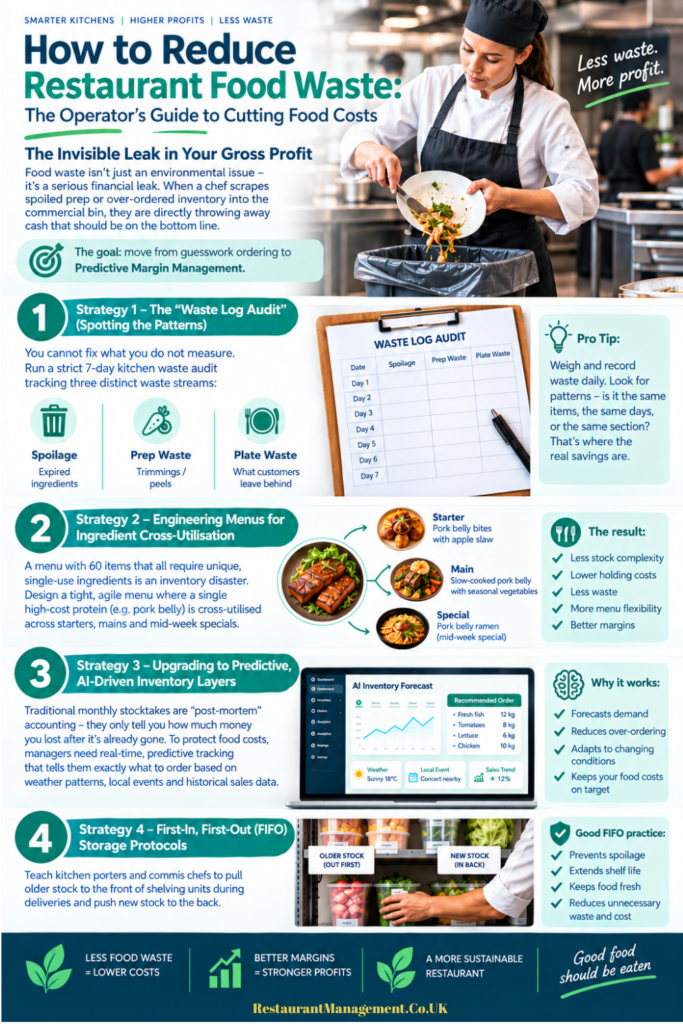
Strategy 1: The “Waste Log Audit” (Spotting the Patterns)
Before you buy a single piece of software or change a line on your menu, you have to face a hard operational truth: you cannot manage what you do not measure.
If you ask most restaurant managers how much food waste their kitchen generates, they’ll usually say, “Oh, not much, we run a tight ship.” But if you look inside their commercial wheelie bins at the end of a Saturday night, you’ll find the reality is completely different. Money is silently leaking out of the building because kitchens treat food waste as an inevitable cost of doing business rather than a trackable metric.
To plug this leak, implement a strict 7-day Kitchen Waste Audit.
The goal isn’t to make your chefs feel guilty. It is to isolate exactly where your inventory is dying. To do this effectively, your kitchen team must categorise and weigh every single item of food before it hits the bin, dividing it into three distinct waste streams:
- Spoilage Waste: Ingredients that rotted, expired, or went out of date before you could prep them (e.g., a slimy bag of spinach or sour milk). This points to an ordering and supply chain issue.
- Prep Waste: Food lost during kitchen production (e.g., heavy trimmings from beef fillets, potato skins, or burnt batches of sauce). This points to a knife-skill or training issue.
- Plate Waste: What your customers leave behind on their plates when they finish dining. This points to a portion-size or menu engineering issue.
If you try to get your team to track this by typing numbers into a computer screen during a busy service, it will fail. It has to be dead simple, highly tactile, and physically built into the kitchen workflow.
The easiest way to kickstart this audit is to place a dedicated, heavy-duty waste station right next to your prep benches, kitted out with a few rugged, low-cost essentials from Amazon UK.
First, your chefs need to weigh the waste accurately before throwing it away. Scraping a gastro pan onto a flimsy digital baking scale will break it within a week. Instead, mount a rugged, waterproof bench scale like the Wedderburn / My Weigh UltraShip Electronic Scale on your waste station. It handles heavy bins up to 25kg, has a detachable display so chefs can read numbers even under massive prep tubs, and wipes down easily with sanitiser at the end of the shift.
Second, your team needs a highly visible, frictionless way to record those weights instantly. If they have to go hunting for a pen or log into an app, they’ll skip it. Screw a magnetic, heavy-duty, wall-mounted stainless steel clipboard directly above the waste bin. Clip a water-resistant, daily tracking sheet to it with a pen tethered to the board.
Finally, keep the tracking data front and centre for the whole team to see. At the end of every service, the junior chef should tally up the daily totals and write them onto a large Magnetic Dry-Erase Kitchen Whiteboard mounted right by the staff clock-in machine.
When your whole team can see that you wasted 14kg of food prep and 8kg of spoiled beef on one Thursday, it makes a big difference. This helps create a work environment where everyone feels responsible. It turns your kitchen staff into partners in protecting your profits.
Managing Restaurant Training: 14 Actionable Tips You Need To Know
What are the best ways to reduce food waste?
If you want the highest return on investment, the best way to reduce food waste is to focus your energy on these three high-impact areas.
| Best Method | Why it works | How to do it |
| Accurate Forecasting | Prevents waste before it even enters your kitchen. | Use EPoS data and weather patterns to drive your ordering. |
| Menu Engineering | Simplifies your inventory and increases ingredient turnover. | Design dishes that share ingredients so nothing sits idle. |
| Staff Training | Builds a workplace culture centered on efficiency. | Run quick, 15-minute waste awareness sessions for kitchen teams. |
Restaurant Food Cost & Waste Checklist.
You don’t need to slash the Restaurant Food Cost & Waste Checklist.
- Set Up Your Physical Audit Station: Designate a specific bench next to your kitchen bins tomorrow morning. Equip it with a rugged My Weigh UltraShip Electronic Bench Scale and a wall-mounted clipboard to weigh and log every gram of spoilage, prep, and plate waste.
- Launch a 7-Day Waste Review: Task your sous chefs with running a strict 7-day waste tracking audit. Tally daily waste weights on a prominent Bi-Office Magnetic Dry-Erase Whiteboard near the staff clock-in station to build team-wide accountability.
- Audit Your Menu for Single-Use Ingredients: Sit down with your head chef and print out your current menu matrix. Highlight any fresh ingredient that only appears in a single dish. Brainstorm three ways to cross-utilise or eliminate those single-use components to cut your walk-in spoilage risk.
- Upgrade your storage to FIFO containers. Check your line’s storage setup during a busy service. If your prep is in all sorts of mismatched tubs then replace those with clear stackable Araven Gastronorm Containers and FIFO Squeeze Bottles so that the old stuff is used first.
- Explore Predictive Inventory Software: If you run multiple sites or manage complex menu cycles, stop guessing on your prep sheets. Book a demo with an AI-native operational layer like Nory AI to integrate live sales forecasting with your supply chain and automate your mid-week ordering.
- Your food cost percentages by reducing portion sizes or compromising the quality of your dishes.
Menu Engineering: How to Identify Your Most and Least Profitable Dishes
Strategy 2: Engineering Menus for Ingredient Cross-Utilisation
Once your waste audit shows exactly what is ending up in your bins, your next move isn’t to hound your chefs about their knife skills—it’s to take a cold, hard look at your menu layout.
A high food cost % almost always comes down to menu design. If you’ve got a 50- or 60-item menu and half of those items require a very specific, single-use ingredient that doesn’t appear on any other item, your kitchen is built for waste.
Think about that speciality smoked duck breast or that specific artisan goat’s cheese used only as a garnish on one slow-selling starter. You are forced to order those ingredients in minimum Supplier quantities. If that starter doesn’t sell well on a quiet Monday or Tuesday night, those premium ingredients sit in your walk-in fridge, get closer to their expiry date, and eventually get thrown away.
To fix this, you need to transition your business to Agile Menu Engineering through strict ingredient cross-utilisation.
The golden rule of a high-margin, low-waste menu is simple: every single fresh ingredient you order from your suppliers must pull double or triple duty across your menu.
Take a high-cost protein like pork belly as an operational example:
- The Starter: Cure and crisp up the trimmings to serve as a pork belly bite or a topping for a seasonal flatbread.
- The Main: Slow-roast the prime centre-cut loin for your flagship mid-week dinner menu or Sunday roast feature.
- The Lunch/Mid-week Special: Shred any remaining meat into a rich pork ragu or a premium bao bun filling for your corporate lunch crowd.
By building your menu around a tight core of versatile, cross-utilised ingredients, you do three critical things for your margins: you massively increase your buying power with suppliers by ordering larger volumes of fewer items, and you speed up inventory turnover. As a result, food stays fresh, and you drastically reduce the risk of any single component spoiling on the shelf.
Operationally, running an engineered, cross-utilised menu means your kitchen storage and line setup must be flawlessly organised. If prepped ingredients are buried in chaotic, mismatched containers, your chefs will lose track of shelf lives, leading to accidental double-prepping and unnecessary waste. Your line setup must be flawlessly organised. If prepped ingredients are buried in chaotic, mismatched containers, your chefs will lose track of shelf lives, leading to accidental double-prepping and unnecessary waste.
To keep your cross-utilised prep line fully tracked and transparent, upgrade to clear, commercial-grade plastic storage systems. Swap opaque takeout tubs for clear, stackable Araven Gastronorm Food Storage Boxes with Color-Coded Lids from Amazon UK. Because these boxes are fully translucent and feature integrated, colour-coded clips, your team can see at a glance exactly how much prepped pork belly or diced garnish is left, ensuring old prep is used up before new boxes are cracked open.
Also, when managing multiple sauces or dressings that use the same base ingredients across starters and mains, avoid messy ladles and open bowls. Equip your line with Fifo Innovations First-In, First-Out Squeeze Bottles. Because these bottles fill from the top and dispense from the bottom, they ensure the oldest batch of sauce is always used first, eliminating stagnant prep buildup at the bottom of the bottle.
Strategy 3: Upgrading to Predictive, AI-Driven Inventory Layers
If you are still managing your kitchen’s stock with monthly manual stocktakes, clipboard gut-feel checks, and a messy Excel spreadsheet, you aren’t controlling your food costs—you are doing a financial post-mortem.
Counting what is left in your dry stores at month-end only tells you how much money you lost after the food has already spoiled, been over-portioned, or ended up in the commercial bin.
To protect your gross profit margins, you need to transition from reactive counting to Predictive Inventory Control.
The traditional way an independent venue or multi-site group creates a prep sheet is flawed. The head chef looks at what they sold last Tuesday, checks the weather app, and guesses how many portions of braised pork belly or prepped salmon fillets they need for the upcoming shift. But human guesswork cannot accurately calculate how a sudden drop in temperature, a local football match, or payday weekend trends will shift your ingredient demand.
If your team over-guesses, then you’ve got thousands of pounds of fresh prep rotting on the shelf. If they under-guess, then you’re out of your best-selling dish by 8.00 pm, unhappy guests and money down the drain.
To eliminate this operational friction, top-tier UK operators are completely bypassing traditional stock software and moving toward unified, AI-driven operating layers. This is exactly where an advanced hospitality system like Nory AI changes the game for modern restaurant groups.
Unlike basic stock systems that act as passive digital ledgers, Nory acts as an intelligent, predictive brain for your back-of-house operations. It sits directly on top of your existing EPOS system, pulling live sales data and blending it with external variables like hyper-local UK weather forecasts, historic seasonal trends, and public holidays.
By analysing these data points, Nory’s machine learning algorithms can predict your daily sales with up to 95% accuracy.
Instead of your kitchen team guessing what to order from suppliers, Nory generates predictive ordering schedules and precise, down-to-the-gram daily prep sheets. It tells your team exactly what ingredients to defrost, chop, and portion based on what your customers are actually going to buy that day.
By moving your stock management into a live, predictive ecosystem, you tightly control ingredient shelf-life, optimise your supply chain logistics. By putting your stock management into a live, predictive environment you have complete control over ingredient shelf life, you can optimise your supply chain logistics and you can reduce your overall kitchen food waste by up to 30%. It takes the admin off the head chef’s plate so that they can focus on plate quality and team training instead of spreadsheets.
For your kitchen team, this completely eliminates the guesswork from ordering. Nory generates predictive ordering schedules and precise, down-to-the-gram daily prep sheets. It tells your team exactly what ingredients to defrost, chop, and portion based on what your customers are actually going to buy that day.
Predictive Staff Scheduling: Empower Successful Restaurant Businesses
Strategy 4: First-In, First-Out (FIFO) Storage Protocols
You can have the most sophisticated predictive software in the world, but if your physical storage setup is a complete mess, your kitchen will still bleed money. The final line of defence against food waste is fundamental operational discipline in your walk-in fridges, freezers and dry stores.
This is the First-In, First-Out (FIFO) rule.
It sounds elementary, but in the heat of a busy delivery drop, standard rotation is often the first thing to fall apart. When a fresh order of dairy, vegetables, or meat arrives, a rushed commis chef or kitchen porter will instinctively push the new boxes right to the front of the shelf because it’s faster. The older stock gets shoved to the back, becomes buried in the dark, and sits there until it goes sour or mouldy.
Implementing a strict FIFO protocol means training every member of your team—from your senior sous chef to your part-time kitchen porter—to follow a simple two-step delivery routine: pull the older stock forward and load the new stock at the back.
It takes an extra 10 seconds per crate but ensures you’re using the ingredients with the shortest remaining shelf life first, thereby eliminating the hidden pockets of spoilage that are so quietly eating into your gross margin.
However, human discipline will only take you so far if your kitchen is full of mismatched, opaque storage tubs. If a chef has to pop the lid off five different white containers to see what prep is inside, they will lose patience during a heavy rush and grab whatever box is closest. Clear, structured storage systems are absolutely mandatory for FIFO to work.
To make stock rotation automatic and effortless for your team, upgrade your walk-in line with professional storage essentials from Amazon UK.
First, ditch opaque packaging and wrap-covered bowls that hide your food. Move your prep into completely translucent, heavy-duty commercial storage boxes like Araven Gastronorm Polypropylene Containers with Colour-Coded Clips. Because these containers are crystal clear and feature integrated, colour-coded clips for different food groups, your chefs can audit your inventory levels at a glance from across the room. Keep older prep visible at the front, making it the path of least resistance for a line cook in a hurry.
Second, think about your high-frequency line items like house sauces, dressings, and garnishes. Storing these in standard squeeze bottles means chefs constantly top up the container from the top, so the older sauce at the bottom sits there indefinitely and spoils.
Protect your sauce line with FIFO Innovations First In, First Out squeeze bottles. These clever little bottles fill from the top and dispense from the bottom. Every time a chef squeezes a bottle of their house aioli or signature jus onto a plate, they automatically use the oldest batch first. It’s the perfect way to keep your prep rotation foolproof and your kitchen running like a well-oiled machine, with nothing going to waste.
FAQ’S
Here are the direct answers to the most common questions about reducing food waste, broken down by actionable lists and clear steps.
What are the 5 steps to reduce food waste?
5 Steps to Reduce Food Waste
This structured approach helps you build a permanent waste-reduction system in your kitchen.
- Audit: Track and weigh what you throw away for one week to see if your biggest issue is prep waste, spoilage, or plate waste.
- Forecast: Look at historical sales data and reservations to order and prep only what you realistically expect to sell.
- Store: Organize fridges using First-In, First-Out (FIFO) and strict temperature logs to maximize shelf life.
- Adapt: Shrink portion sizes of items that regularly come back on plates unfinished, and cross-utilize ingredients across your menu.
- Donate: Partner with local charities, food banks, or surplus food apps to ensure edible leftover food doesn’t go to the bin.
What are 10 ways to reduce food waste?
10 Ways to Reduce Food Waste: practical tactics you can implement across your purchasing, cooking, and front-of-house operations:
- Conduct regular stocktakes: Count your inventory frequently to catch surplus items before they spoil.
- Buy imperfect produce: Purchase “wonky” vegetables from suppliers at a discount for soups, sauces, and purées.
- Optimise prep methods: Train chefs in precision knife skills to maximise yield from meat, fish, and vegetables.
- Repurpose scraps: Turn vegetable peelings into stocks, stale bread into croutons, and herb stems into oils or pestos.
- Reduce menu size: Offer a smaller, more focused menu to streamline your ingredient list and keep stock fresh.
- Offer flexible portions: Let customers choose between small and large portions, or skip standard sides like chips.
- Engage front-of-house staff: Have servers highlight daily specials that use ingredients nearing their expiry date.
- Provide doggy bags: Encourage diners to take their leftovers home in eco-friendly packaging.
- Freeze strategically: Safely blast-freeze any surplus stock, sauces, or proteins before they pass their use-by date.
- Join surplus networks: use digital platforms to sell surplus at a discount in the final hour of service.
Related articles:
Menu Engineering: How to Identify Your Most and Least Profitable Dishes
Predictive Staff Scheduling: Empower Successful Restaurant Businesses
How To Read Restaurant Profit And Loss Statement Masterfully
Managing Restaurant Training: 14 Actionable Tips You Need To Know
Wrapping It Up: Your Margin Protection Action Plan
Cutting your restaurant’s food waste isn’t about reducing portion sizes or compromising ingredient quality. It’s a very specific operational discipline that comes down to smart menu design, physical kitchen accountability and predictive technology.
By improving your food inventory, you can boost your profits. Even a small reduction in food waste wil help you save on your food costs. Instead of waiting until problems arise and using spreadsheets to track everything, take a more organised, planned approach in your kitchen.
You don’t have to change everything at once. Start by checking your food stock carefully. Identify which ingredients you throw away most, and use that information to improve ordering and tracking going forward. To help you get started with your kitchen team this week, here’s a simple checklist for keeping food costs in check.
How To Read Restaurant Profit And Loss Statement Masterfully