

Predictive Staff Scheduling That Cut Labour Costs
The most successful restaurant operators begin their week with accurate forecasting, convert that forecast into labour requirements, construct shifts around expected demand, and continually review performance against actual trading results. The predictive staff scheduling data approach changes how they create work schedules.
Predictive staff scheduling data allows restaurants, pubs, cafés, hotels and multi-site operators to forecast customer demand before building staff rosta. Instead of reacting to problems after they occur, managers can anticipate busy periods, allocate labour more efficiently and reduce unnecessary payroll costs while maintaining excellent customer service.
Staff wages are among the highest controllable costs in hospitality. Even a well-run restaurant can see profitability suffer when too many employees are scheduled during quiet trading periods, or too few are available during busy service. Many traditional ways of making staff schedules rely on past schedules, personal preferences, or fixed patterns rather than actual customer needs. While experience is important, modern hospitality managers now have access to far more information to help them create better schedules.
This predictive data approach helps you create a better staffing plan based on facts rather than just guessing. This approach makes scheduling more efficient and accurate, leading to better use of resources and improved operational results.
What is predictable staff scheduling?
Predictable staff scheduling is a way of making work schedules clear and known in advance, usually at least two weeks before the work starts. This approach helps everyone by making work times more regular. For workers, it provides stability, so they can plan their personal lives better and balance work with other activities. For employers, having predictable schedules can improve worker happiness, lower the number of workers leaving their jobs, and help with planning business operations. Overall, using predictable scheduling can lead to a more engaged and productive team.
Why Predictive Scheduling Matters
Labour costs usually make up a big part of the money spent in the restaurant industry. This is why creating a good work schedule is very important for maintaining healthy profits. If you have too many staff, you spend more on wages without earning more. On the other hand, having too few workers can lead to slow service, unhappy guests, tired staff, and lost sales. It’s all about finding the right balance.
Predictive scheduling aims to place the right number of people, with the right skills, in the right place at the right time. Rather than treating every Friday or Saturday as identical, predictive planning recognises that demand changes constantly due to reservations, weather, local events, holidays, promotions and seasonal trends.
When forecasting becomes part of the weekly planning process, managers spend less time making emergency rota changes, calling in staff at short notice or paying unnecessary overtime. Instead, staffing levels become aligned with actual business activity.
Key Takeaway: Effective rota optimization starts with forecasting customer demand—not copying last week’s schedule.
How To Not Get Overwhelmed With Restaurant Employee Scheduling!!
Build a Reliable Demand Forecast First
Bring All Your Business Data Together: Accurate forecasting begins with quality data. The more complete your information, the more reliable your staffing decisions become.
Best practice is to combine several data sources into a single forecasting process, including:
- Historical POS or EPOS sales
- Covers by service period
- Revenue by hour
- Average transaction value
- Product mix
- Reservations
- Private dining bookings
- Delivery platform demand
- Weather forecasts
- School holidays
- Public holidays
- Local sporting events
- Concerts and festivals
- Planned promotions
- Marketing campaigns
- Menu launches
- Training days
Rather than manually updating multiple spreadsheets, many operators benefit from systems that automatically refresh forecasts as new bookings and external information become available.
Forecast at the Right Level of Detail
Daily sales forecasts are helpful, but hourly forecasting provides much greater value when creating rotas.
Breaking the day into 15 or 30-minute intervals allows managers to identify lunch rushes, evening peaks and quieter trading periods with much greater precision. Staffing requirements for a restaurant between 12:00 pm and 2:00 pm are often very different from those at 3:30 pm, even on the same day.
Forecasts should also be separated by department wherever possible, including:
- Restaurant
- Bar
- Kitchen
- Delivery
- Events
- Private dining
Looking two to four weeks ahead provides enough time to publish rotas while still allowing forecasts to be updated as bookings increase or weather conditions change.

Use AI Where It Adds Value
Large restaurant operators with multiple locations can use advanced technologies, such as AI tools, to identify important trends that single operators might overlook. For example, they can find that when it rains on Thursday nights, bar sales drop, but more people come to the restaurant. Additionally, these systems can recognise how local sports events affect lunch customers differently than dinner customers. This information helps restaurants make better decisions about how to run their businesses and market themselves.
However, technology is only as good as the data feeding it. Before implementing AI forecasting, businesses should ensure their historical sales, labour and booking data are complete and accurate. Poor-quality information produces poor-quality forecasts.
Turn Forecasts into Labour Requirements
Define Labour Standards: After demand forecasting is complete, it is imperative for management to establish precise labour standards that translate projected sales into specific staffing needs.
Examples include:
- One server for every twenty covers per hour.
- One bartender for a defined level of beverage sales.
- One chef based on expected food revenue or production volume.
Labour standards usually fall into three categories:
Minimum Staffing
These are essential positions that must always be filled regardless of demand.
Examples include:
- Host
- Supervisor
- Duty manager
Fixed Staffing
These positions remain relatively constant.
Examples include:
- Head chef
- Restaurant manager
Variable Staffing
These increase or decrease according to business levels.
Examples include:
- Waiting staff
- Bartenders
- Kitchen porters
- Food runners
Separating staffing this way allows operators to maintain service standards while scaling labour efficiently.
Restaurant Margins – The Ultimate Guide to Boosting Revenue & Efficiency
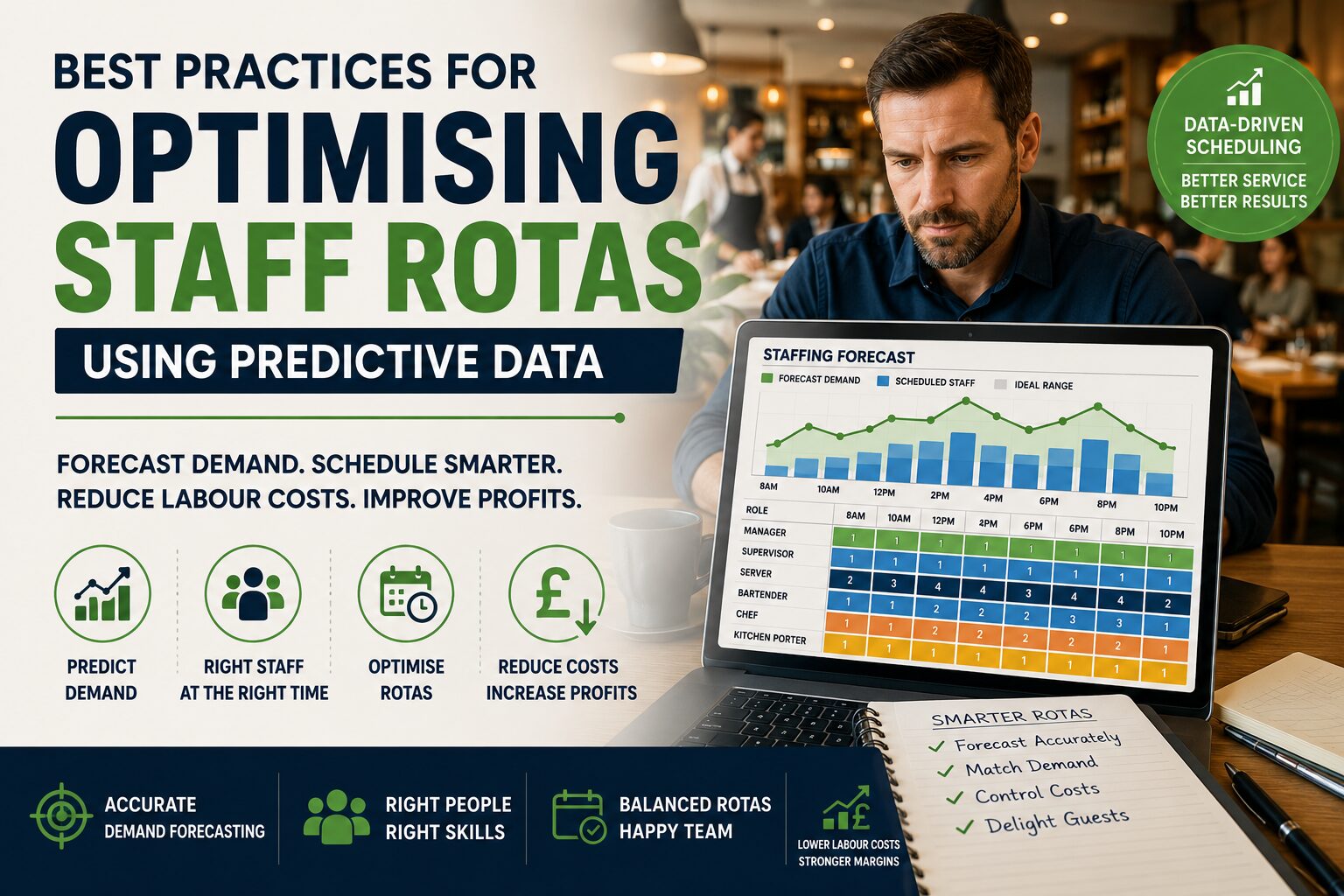
Create a Visual Labour Demand Curve
Many workforce management platforms display labour demand as a graph.
The forecasted number of covers or expected revenue appears throughout the day alongside the scheduled number of employees.
This visual comparison quickly highlights periods where staffing exceeds demand or where additional employees may be required.
Instead of analysing rows of spreadsheet data, managers can immediately see whether shifts properly cover anticipated trading patterns.
Build Rotas Around Demand Instead of Habit
Stop Copying Last Week’s Schedule: One of the biggest scheduling mistakes is using previous rotas as the starting point.
Every trading week is different.
Reservations change.
Events change.
Weather changes.
Customer behaviour changes.
Instead of repeating old schedules, each rota should begin with the latest demand forecast.
Busy periods should receive additional coverage, while quieter trading windows should have fewer scheduled employees.

Use Flexible Shift Patterns
Traditional full-day shifts often result in higher labour costs during off-peak periods. To optimise operational efficiency in their restaurants, many operators now implement shorter shifts tailored to align with projected demand surges. This strategy enables better resource allocation and cost management by ensuring that the number of staff matches actual changes in work demand.
For example:
- 11:30 am–3:00 pm for lunch
- 5:30 pm–10:00 pm for dinner
Split shifts and targeted shift blocks allow staffing to follow customer demand far more closely than fixed all-day schedules.
Some businesses also use open shifts during periods of uncertain demand, allowing employees to claim additional work once bookings justify the extra labour.
Balance Skills, Availability and Compliance
Good scheduling involves more than assigning shifts; it requires careful consideration of employee skills, availability, and other key factors:
- How experienced each person is
- The special skills needed for each job
- When employees are free to work
- The number of hours they are hired to work
- Making sure everyone gets their required rest breaks
- Follow the industry regulations about how many hours employees can work each week.
- Follow the industry guidelines for hiring young workers.
- Share weekend work shifts fairly among all team members.
By incorporating these factors, managers can improve workforce planning and boost operational efficiency.
Scheduling software can automate many of these rules, helping managers feel confident that legal compliance is consistently maintained while reducing administrative effort.
UK Restaurant Industry Statistics & Trends 2026 You Need To Survive
Prevent Fatigue and Improve Fairness
Efficient rotas should never come at the expense of employee wellbeing.
Before publishing schedules, managers should review whether premium evening shifts and weekends are shared fairly across the team.
They should also check for excessive consecutive working days and “late-early” shift combinations that leave employees with insufficient recovery time.
Balanced schedules contribute to higher morale, better service and improved staff retention, reducing recruitment costs over time.
Remember: Fair rotas often deliver better long-term financial results than simply minimising payroll hours.
Use Scenario Planning Before Publishing
Forecasts are predictions rather than guarantees.
Unexpected weather, transport disruption or local events can significantly affect customer demand.
Instead of relying on a single forecast, many successful operators prepare multiple scenarios.
These typically include:
- Best-case demand
- Expected demand
- Lower-demand scenario
Managers can then identify a core staffing plan while maintaining a list of flexible employees to call upon if demand exceeds expectations.
Predetermined trigger points—such as reservations reaching 80% capacity several days before service—allow businesses to react calmly rather than making expensive last-minute staffing decisions.

Review Performance Every Week
Compare Forecast Against Reality: Forecasting improves through continuous learning.
Each week, managers should compare:
- Forecast covers
- Actual covers
- Forecast revenue
- Actual revenue
- Planned labour hours
- Actual labour hours
Consistent differences highlight where forecasting assumptions require adjustment.
For example, if people often think Monday lunches will be busier than they really are, or if Friday evenings usually have more customers than expected, you can adjust your plans based on this information. This helps you improve over time rather than just making forecasts once and forgetting about them.
Monitor Key Labour KPIs
Several performance indicators help measure scheduling effectiveness.
Understanding Key Labour Metrics
If you want to manage your work schedules better, it helps to track a few key labour metrics. Here are some useful indicators to help you see how you’re doing:
- Labour Cost Percentage: This indicates the share of your total costs that goes to employee wages. It can help you keep labour costs in check and plan your budget more easily.
- Revenue per Labour Hour: This shows how much money you earn for every hour an employee works. It helps you see how productive your team is.
- Planned vs Actual Hours Worked: When you compare the hours you scheduled with the hours actually worked, you can spot any gaps. This helps you use your team more effectively.
- Overtime Percentage: This tracks the percentage of hours worked beyond the usual schedule. It helps you see how overtime affects your costs and your employees’ well-being.
- Agency Labour Usage: By tracking how many temporary or contract workers you use compared to permanent staff, you can learn more about your hiring approach and how well you adapt to changes in demand.
- Forecast Accuracy: This measures how closely your predictions of customer needs align with what actually happens. It helps you plan and use your resources wisely.
- Schedule Adherence: This looks at how well your planned schedules line up with the shifts your team actually works. It shows how accurate and dependable your scheduling is.
By tracking these metrics, organisations can improve their scheduling and overall labour performance.
11 Powerful Restaurant Growth Goals You Should Set Right Now
Improve Communication Across the Team
Publish Rotas Early: Employees value certainty.
Publishing schedules at least two to three weeks in advance allows staff to organise their personal commitments while reducing requests for last-minute changes.
Digital workforce applications also simplify shift swaps, availability updates and manager approvals, ensuring every rota change remains visible and properly controlled.
Clear approval processes reduce unauthorised overtime while giving managers greater confidence in labour planning.
Train Managers to Use Data
Using forecasting software by itself will not improve scheduling.
Managers should feel confident when reading forecasts and understanding labour demand graphs.
Training can support managers in several ways:
- Reading forecasting dashboards
- Understanding staffing
- Recognising unusual trading patterns
- Applying local knowledge
- Making informed scheduling adjustments
Technology can guide decisions, but experienced managers are still needed to interpret situations that data alone cannot predict.

Start Small and Expand Gradually
Businesses introducing predictive scheduling do not need to transform every site immediately.
A pilot programme involving one or two locations often provides valuable insight before wider implementation.
Running a structured trial over several weeks allows operators to evaluate improvements in labour efficiency, overtime, scheduling accuracy and forecast performance across multiple trading cycles.
Lessons learned during the pilot can then be documented and adapted before expanding the approach across additional venues.
For larger hospitality groups with multiple sites and complex staffing requirements, predictive scheduling often delivers the greatest operational benefits by providing consistency, which lets managers focus on the needs of their local customers.
Predictive Rota Optimisation Checklist
Before publishing every rota, ensure you have completed the following:
- ✔ Integrate POS, reservation and external forecasting data.
- ✔ Forecast demand by daypart and department.
- ✔ Define minimum, fixed and variable labour standards.
- ✔ Build shifts from forecast demand rather than previous rotas.
- ✔ Compare scheduled labour against expected workload.
- ✔ Check compliance, fairness and employee fatigue.
- ✔ Publish schedules well in advance.
- ✔ Monitor labour KPIs every week.
- ✔ Compare forecast performance with actual trading results.
- ✔ Continuously refine forecasting assumptions.
Conclusion
Optimising staff rotas with predictive data enables hospitality businesses to schedule labour based on expected customer demand rather than assumptions or historical habits. By combining sales data, reservations, external influences and operational knowledge, managers can create schedules that better reflect real trading conditions while supporting service quality.
The process does not end once the rota is published. Regularly reviewing forecast accuracy, monitoring labour performance and refining staffing standards creates a continuous improvement cycle that strengthens operational decision-making over time. Whether managing a single venue or a multi-site operation, a forecast-led approach provides a more structured, consistent and informed method of labour planning that helps protect profitability while supporting both employees and guests.
Read Further
Continue building your hospitality management knowledge with these related guides:
How To Not Get Overwhelmed With Restaurant Employee Scheduling!!
5 Proven Cash Flow Controls That Protect Your Restaurant Profits
Restaurant Budgeting: How to Build a Profitable Financial Plan
Restaurant Margins – The Ultimate Guide to Boosting Revenue & Efficiency
11 Powerful Restaurant Growth Goals You Should Set Right Now