

Menu Engineering
A restaurant menu should do more than tell customers what they can order. It should also help the operator understand which dishes are driving sales and which ones are contributing most to the business. This is where menu engineering becomes particularly useful. The traditional menu engineering matrix evaluates each dish using two measures: popularity, based on how often it sells, and profitability, based on its per-sale contribution margin. Combining these two measures places dishes into four categories: Stars, Plowhorses, Puzzles and Dogs.
The important point is that a dish can be popular without being particularly profitable, or highly profitable without attracting many customers. Looking at sales volume alone can therefore lead to poor menu decisions. Likewise, relying solely on food-cost percentage can give you an incomplete picture of what a dish is actually contributing. Menu engineering brings popularity and contribution margin together so you can make more informed decisions about pricing, promotion, recipe costs and menu space.
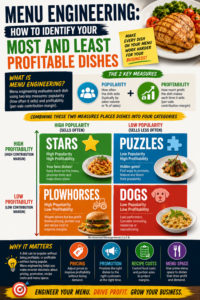
How the Four Menu Engineering Categories Work
The menu engineering matrix divides dishes into four groups. Each category tells you something different about how that item is performing and suggests a different management response.
| Category | Popularity | Contribution Margin | Typical Action |
| Stars | High | High | Protect and promote |
| Plowhorses | High | Low | Improve margin |
| Puzzles | Low | High | Promote and reposition |
| Dogs | Low | Low | Review, redesign or remove |
The dividing points should normally be based on the performance of your own menu, rather than an arbitrary industry figure. A common approach is to compare each item’s sales and contribution margin with the menu’s averages or the chosen popularity benchmark for the analysis period. The important thing is to use the same method consistently when reviewing the menu.
Stars: Popular and Profitable
Stars are the dishes every restaurant wants to have. They combine strong customer demand with a contribution margin above the relevant menu benchmark. In simple terms, customers like buying them and the restaurant makes a healthy contribution from each sale.
These dishes deserve protection. Keep the recipe consistent, make sure the kitchen can produce them reliably, and give them appropriate visibility on the menu. They can also be good candidates for recommendations from front-of-house staff because there is already evidence that customers want them.
However, don’t assume a Star can be changed without consequences. If an item is performing particularly well, unnecessary changes to its recipe, portion, presentation or price could affect demand. The better approach is to understand why it works and protect the characteristics that customers value.
What Should You Do With a Star?
- Keep quality and portion sizes consistent.
- Make sure the dish is reliably available.
- Give it appropriate prominence on the menu.
- Train staff to recommend it naturally.
- Monitor its sales and contribution margin regularly.
- Review ingredient costs so its margin doesn’t gradually deteriorate.
A Star is not a dish you leave alone forever. Supplier prices change, customer preferences change, and competitors change. Continue monitoring it, but avoid fixing something that isn’t broken.
Restaurant Menu Planning: 12 Tips On How to Design the Perfect Restaurant Menu
Plowhorses: Popular but Lower Margin
Plowhorses are particularly interesting because they sell well but generate a contribution margin below the menu benchmark. They are often the dishes customers know, trust and repeatedly order, yet the restaurant isn’t getting as much contribution from each sale as it could.
This is where an operator needs to be careful. Removing a popular Plowhorse simply because its food-cost percentage looks high could be a mistake. The dish may be an important part of the restaurant’s customer appeal. Instead, investigate whether there is a sensible way to improve its contribution margin.
Possible approaches include reviewing the recipe, reducing unnecessary ingredient costs, improving portion control or making a carefully considered price adjustment. Any change should be tested against customer demand and the overall positioning of the restaurant rather than made purely to hit a particular percentage.
What Should You Do With a Plowhorse?
- Review the recipe and ingredient costs.
- Check portion sizes and preparation methods.
- Investigate alternative ingredients where quality can be maintained.
- Review whether the selling price still reflects the cost of producing the dish.
- Consider a carefully tested price increase.
- Monitor customer response after making changes.
The objective isn’t necessarily to turn every Plowhorse into a Star. The objective is to make a popular dish work harder financially without destroying the demand that made it successful in the first place.
Puzzles: Profitable but Less Popular
Puzzles present the opposite challenge. They have a strong contribution margin but don’t sell in sufficient volume. In other words, there is money to be made from the dish, but customers aren’t choosing it often enough.
Before removing a Puzzles, ask why customers are overlooking it. The problem may have nothing to do with the food itself. The dish could have an unappealing name, a weak description, poor menu positioning, limited visibility, or a price that doesn’t appear to offer enough value.
This is where menu presentation and staff recommendations can influence customer choices. Improving descriptions, positioning, or timing can significantly boost sales of underperforming items.
What Should You Do With a Puzzle?
- Review its position on the menu.
- Improve the description if it doesn’t communicate the dish’s appeal.
- Consider whether the name is helping or hurting sales.
- Train staff to recommend it appropriately.
- Test it as a special or featured dish.
- Monitor sales before deciding whether to remove it.
The key is to test rather than guess. If the dish remains unpopular after reasonable attempts to improve its visibility and appeal, it may no longer justify the menu space, preparation time and inventory requirements it consumes.
Dogs: Low Popularity and Low Margin
Dogs occupy the least attractive position in the traditional matrix because they perform poorly on both measures-low contribution per sale and infrequent orders-indicating limited profitability and customer demand.
That doesn’t automatically mean every Dog should be removed. A dish may have a strategic purpose that isn’t captured by the matrix—for example, it may provide an important dietary option or complete a particular section of the menu. Recognising this can help managers feel their broader perspective is appreciated. However, if an item has no clear strategic role and consistently performs poorly, removing it can simplify purchasing, preparation and menu management.
Before taking a dish off the menu, check that the recipe cost is correct and that the sales data covers a sufficient period. Keep in mind that a dish that appears to be a “Dog” during a quiet month might perform better over the long term or in different seasons. Recognising seasonal variations can help managers feel their observations are important and support better decision-making.
What Should You Do With a Dog?
- Check that the recipe cost is accurate.
- Review its sales over a representative period.
- Determine whether it serves a strategic purpose.
- Consider whether the recipe or presentation can be improved.
- Remove it if it consistently performs poorly and has no clear role.
Removing weak dishes can also make the menu easier for customers to navigate and may reduce the number of ingredients the kitchen needs to hold. But the decision should be based on evidence rather than simply labelling an unpopular dish a failure.
How Much Revenue Does a Restaurant Need to Survive? Exposed!
Contribution Margin: The Number That Really Matters
One of the most important concepts in menu engineering is contribution margin. It measures the amount left from a menu item’s selling price after deducting its direct food cost.
The basic calculation is:
Contribution Margin = Selling Price − Food Cost
For example, suppose a pasta dish sells for £14 and the food cost per portion is £2.
£14 − £2 = £12 contribution margin
That £12 is not the restaurant’s final profit. It still needs to contribute towards labour, rent, utilities, insurance, marketing and other operating expenses. That’s why the term “contribution margin” is more appropriate than simply calling it “profit”.
Now consider a steak selling for £22 with a food cost of £11.
£22 − £11 = £11 contribution margin
The steak has a higher food-cost percentage, but the pasta contributes £1 more per sale towards the restaurant’s other costs.
| Dish | Selling Price | Food Cost | Food Cost % | Contribution Margin |
| Pasta | £14 | £2 | 14.3% | £12 |
| Steak | £22 | £11 | 50% | £11 |
This is an important distinction. A restaurant should not automatically reject a dish because its food-cost percentage is relatively high. The contribution margin tells you how many pounds the item contributes after its direct food cost has been covered. Menu engineering therefore considers the absolute contribution per sale alongside popularity, rather than relying on food-cost percentage alone.
Food-Cost Percentage Still Has a Role
Even though food-cost percentage is important, it shouldn’t be overlooked. It’s still a perfectly good way to keep track of how much ingredients cost and to spot issues like serving too much food, wasting food, food going bad, or if suppliers raise their prices.
The difference is in how you use the information. Food-cost percentage tells you the proportion of the selling price consumed by food cost; contribution margin tells you the pounds left after that direct food cost. Both figures can provide useful information, but they answer different questions.
For example, a dish with a 15% food cost may look excellent from a percentage perspective, but if it sells for only £8, its contribution margin is £6. Another dish with a 40% food cost, selling for £25, yields a £15 contribution margin. The second dish has the higher food-cost percentage but contributes considerably more money per sale towards the restaurant’s overheads.
This is why experienced operators should look at food cost percentage, contribution margin and sales volume together. No single metric tells the complete story.
Don’t Confuse Contribution Margin With Net Profit
Understanding that contribution margin is not the same as net profit is crucial for making confident menu decisions. Clarifying this distinction helps you feel more competent in financial analysis.
If a dish sells for £22 and has an £11 food cost, its £11 contribution margin doesn’t mean the restaurant earns £11 in final profit. That amount still has to help cover expenses such as staff wages, rent, utilities, insurance, business rates, marketing and other overheads. Recognising this helps you feel more in control of your financial management.
It’s important to know that menu engineering helps restaurants make smarter menu choices. By understanding contribution margin, you can see which dishes make more money and which ones might need some changes. This information helps in making better decisions about the menu. However, it doesn’t take the place of looking at the restaurant’s overall profits and expenses.
How to Use Menu Engineering Properly
Menu engineering works best when the underlying information is reliable. Before classifying dishes, make sure your recipe costs are accurate, portions are consistent and sales data covers a meaningful period. If the recipe says a dish costs £3 to produce but the kitchen regularly uses £4 worth of ingredients because of oversized portions or waste, the analysis will give you a misleading result.
A practical review should therefore bring together:
- Selling price – what the customer pays.
- Accurate food cost – what the portion actually costs to produce.
- Contribution margin – selling price minus direct food cost.
- Units sold – how frequently the dish is purchased.
- Popularity benchmark – the method used to determine high and low popularity.
- Operational context – preparation time, kitchen complexity and strategic importance.
Once you’ve analysed the menu, the objective isn’t to force every dish into the same profitability model. A strong menu can include a variety of dishes that serve different purposes. The value of menu engineering is that it gives the operator a structured way to identify opportunities and problems, rather than relying entirely on instinct.
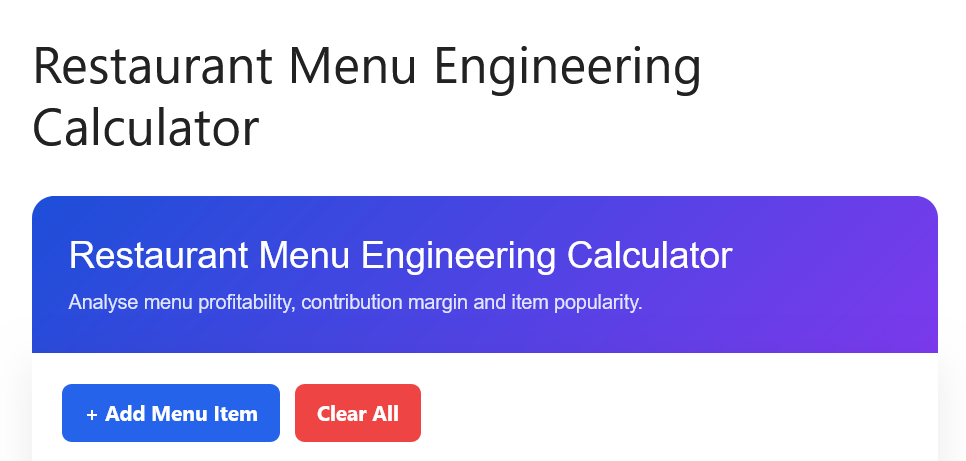
Use our Restaurant Menu Engineering Calculator to analyse item popularity and profitability, identify your best and worst performers, and make smarter menu decisions.
RELATED ARTICLES:
Restaurant Menu Planning: 12 Tips On How to Design the Perfect Restaurant Menu
Restaurant Cash Flow Management Secrets Every Owner Should Know
How Much Revenue Does a Restaurant Need to Survive? Exposed!
Restaurant Budgeting: How to Build a Profitable Financial Plan
How To Be A Successful Restaurant Manager
The Bottom Line
A restaurant shouldn’t ask only, “What are my best-selling dishes?” The more useful question is, “Which dishes sell well and make a strong contribution to the business?”
Stars should generally be protected and promoted. Plowhorses deserve attention because they have demand but may have room for better margins. Puzzles need investigation and potentially better positioning or promotion. Dogs should be reviewed carefully to determine whether they have a legitimate strategic role or whether they are simply consuming menu space and operational resources.
Most importantly, don’t judge a dish on food-cost percentage alone. Contribution margin and popularity tell a much more useful story when they’re considered together. A dish with a higher food-cost percentage can still contribute more pounds per sale than one with a very low food-cost percentage. That’s the practical insight at the heart of menu engineering—and one that can make a significant difference when you are deciding what deserves space on your menu. It’s now time to calculate your menu margins with our special Restaurant Menu Engineering Calculator.
Restaurant Cash Flow Management Secrets Every Owner Should Know