


Square vs Toast POS
Square vs Toast POS, which one? Choosing the right restaurant POS system is very important for anyone running a restaurant. It affects how quickly orders are taken, how efficiently payments are made, and how well the restaurant performs financially. A good system keeps things running smoothly and helps analyse important data, which can improve profits every month.
In this comparison of Square vs Toast POS, we’ll break down pricing, features, ease of use, and real-world restaurant performance so you can decide which system best fits your business.
Key Takeaways (TL;DR)
- Best overall for full-service restaurants: Toast POS
- Best budget-friendly and flexible option: Square
- Best for small cafés and quick-service setups: Square
- Toast is stronger in kitchen operations, restaurant workflows, and scalability
- Square wins on simplicity, affordability, and fast setup
Quick Verdict
- Best overall: Toast POS (for full-service restaurants)
- Best budget option: Square for Restaurants
- Best for small cafés: Square
If you have a busy restaurant with multiple areas, tables, and staff, Toast is designed for that kind of place. But if you want something simple, quick to set up, and affordable, Square is a great choice.
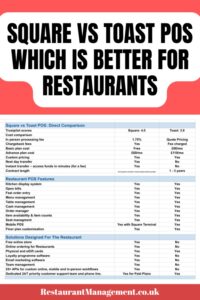
Feature Comparison Table (Square vs Toast POS)
| Feature | Square | Toast POS |
| Pricing | Free + paid tiers | Custom pricing, hardware bundles |
| Ease of use | Very easy | Moderate learning curve |
| Hardware | Bring-your-own + Square devices | Proprietary restaurant hardware |
| Payments | Integrated, flat-rate | Built for restaurant workflows |
| Inventory | Basic–moderate | Advanced restaurant inventory |
| Reporting | Good analytics | Deep restaurant analytics |
| Offline mode | Limited | Strong offline resilience |
| Staff management | Included (basic) | Advanced scheduling & roles |
Square for Restaurants Overview
What is Square for Restaurants?
Square is a cloud-based POS ecosystem designed for simplicity, speed, and accessibility. The restaurant version—Square for Restaurants—extends its core payment system into table service, kitchen coordination, and menu management.
It is especially popular among:
- Cafés
- Small restaurants
- Food trucks
- Bakeries
- Quick-service restaurants (QSRs)
Square’s biggest advantage is its low barrier to entry. Many restaurants can start with minimal upfront cost and scale gradually.
Key Features
Square for Restaurants includes:
1. Order Management
- Fast order entry interface
- Table-side ordering via mobile devices
- Split checks and item-level modifications
2. Payment Processing
- Integrated card payments
- Tap, chip, and contactless support
- Fast checkout flow optimised for speed
3. Menu Management
- Real-time menu updates
- Easy item customisation
- Category-based organisation
4. Reporting & Analytics
- Daily sales summaries
- Item performance tracking
- Basic labour and revenue insights
5. Staff Tools
- Shift tracking
- Basic permissions
- Time clock integration
Pros of Square
- Extremely easy to set up
- Transparent pricing structure
- No long-term contracts
- Great for small teams
- Works on iPads and low-cost hardware
Cons of Square
- Limited advanced kitchen workflows
- Less robust inventory management
- Not ideal for large multi-station restaurants
- Fewer enterprise-grade features
Who Should Use Square?
Square is ideal for:
- New restaurant owners
- Small cafés and bakeries
- Mobile food businesses
- Restaurants prioritising simplicity over complexity
Try Square for Restaurants (Free plan available): https://squareup.com
Toast POS Overview
What is Toast POS?
Toast POS is a restaurant-first platform built specifically for foodservice operations. Unlike general POS systems, Toast is engineered around kitchen workflows, staffing complexity, and high-volume restaurant environments.
It is widely used in:
- Full-service restaurants
- Bars and lounges
- Multi-location chains
- High-volume dining establishments
Toast’s core strength is its end-to-end restaurant ecosystem, from ordering to kitchen display to payroll integration.
Key Features
1. Restaurant-Grade Ordering System
- Table management with visual floor plans
- Server handheld ordering
- Split checks, course management, modifiers
2. Kitchen Display System (KDS)
- Real-time order routing to kitchen screens
- Prep time tracking
- Course prioritisation
3. Inventory & Cost Control
- Ingredient-level tracking
- Recipe costing
- Waste monitoring tools
4. Staff Management
- Shift scheduling
- Labour tracking
- Role-based permissions
- Performance analytics
5. Hardware Ecosystem
- Dedicated Toast terminals
- Handheld devices for servers
- Kitchen display hardware integration
Pros of Toast POS
- Built specifically for restaurants
- Excellent for complex operations
- Strong offline functionality
- Advanced inventory and kitchen workflows
- Scales well for multi-location businesses
Cons of Toast POS
- Higher cost than Square
- Requires contract-based pricing in many cases
- Longer onboarding process
- Hardware dependency can increase startup cost
Pricing Overview
Toast uses a custom pricing model based on:
- Restaurant size
- Hardware needs
- Feature set
- Payment processing volume
Unlike Square, pricing is not fully transparent upfront, which can be a barrier for smaller businesses.
Book a demo with Toast POS (best for full-service restaurants): https://pos.toasttab.com

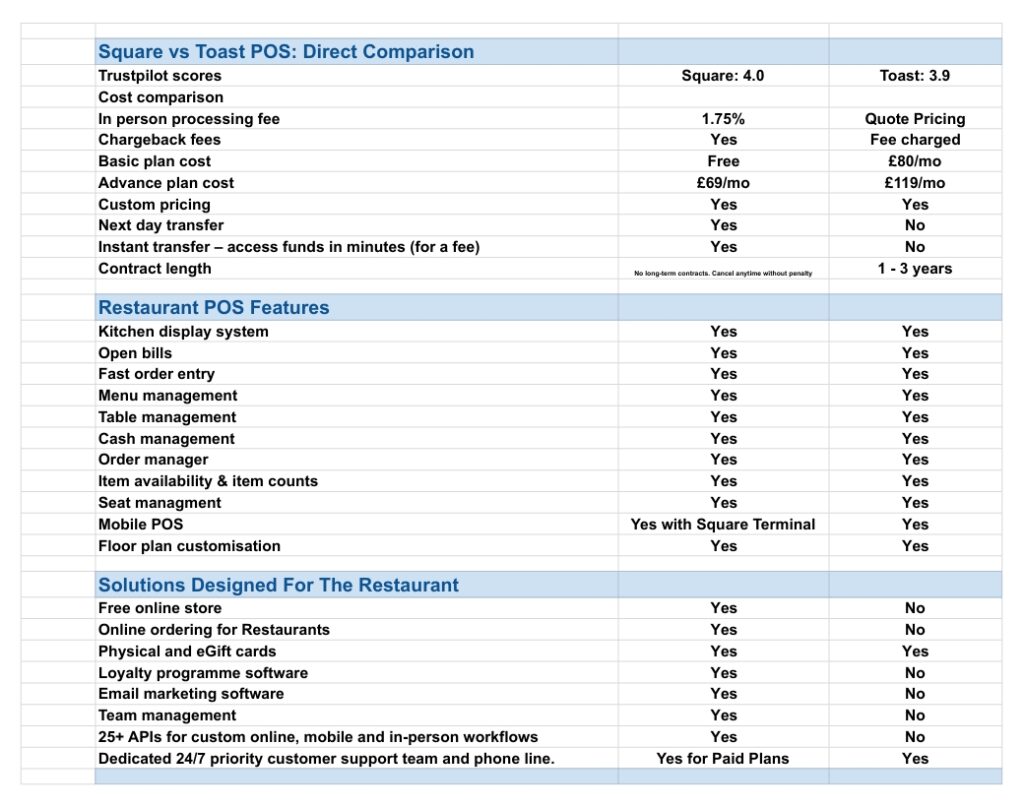
Square vs Toast POS: Direct Comparison
1. Pricing Winner: Square
Square is significantly more accessible for small businesses. Its free tier and transparent transaction fees make it predictable and low-risk.
Toast, while powerful, often requires custom quotes and hardware investment.
Winner: Square
2. Features Winner: Toast POS
Toast dominates in advanced restaurant features:
- Kitchen display systems
- Advanced inventory tracking
- Complex table service tools
- Enterprise-grade reporting
Square is improving but remains simpler by design.
Winner: Toast POS
3. Ease of Use Winner: Square
Square is widely known for its intuitive interface. Staff can be trained in hours rather than days.
Toast requires more onboarding due to its depth.
Winner: Square
4. Hardware & Ecosystem Winner: Toast POS
Toast offers a tightly integrated hardware ecosystem designed specifically for restaurants.
Square is more flexible but less specialized.
Winner: Toast POS
5. Scalability Winner: Toast POS
For multi-location restaurants and high-volume environments, Toast scales more effectively with:
- Centralised reporting
- Multi-unit management
- Advanced labour controls
Winner: Toast POS
Which POS Should You Choose?
Small Café or Bakery → Square
Square works best if you:
- Want fast setup
- Have limited staff
- Don’t need complex kitchen workflows
- Want predictable pricing
Full-Service Restaurant → Toast POS
Toast is ideal if you:
- Manage table service
- Have a kitchen display system
- Need advanced inventory tracking
- Operate at high volume
Food Truck or Mobile Vendor → Square
Square’s mobile-first design makes it perfect for:
- On-the-go payments
- Portable setups
- Fast transactions
Growing Multi-Location Brand → Toast POS
Toast is designed to help businesses grow and manage many locations more easily. It allows for better control and better organisation, making management simpler and more efficient.
Real-World Performance Insights
Restaurants using Toast typically report:
- Reduced order errors due to KDS integration
- Improved kitchen efficiency
- Better labour optimisation
Square users often highlight:
- Faster onboarding
- Lower operational costs
- Simpler daily management
The trade-off is clear: Toast optimises complexity, Square optimises simplicity.
AI in Restaurant Operations: Smarter Systems, Better Margins
FAQ: Square vs Toast POS
Is Square good for restaurants?
Yes. Square is excellent for small to medium-sized restaurants that prioritise simplicity and affordability. It covers essential POS features without overwhelming complexity.
How much does Toast POS cost?
Toast pricing varies based on hardware, features, and restaurant size. Most restaurants receive custom pricing after consultation rather than a fixed public rate.
What is the easiest POS system to use?
Square is widely considered one of the easiest POS systems due to its clean interface and quick setup process.
Can I switch POS systems easily?
Yes, but it requires planning:
- Exporting menu data
- Migrating customer records
- Training staff on new workflows
- Reconfiguring hardware
Square is easier to migrate into; Toast requires more structured onboarding.
Key Insights
- Square and Toast solve different problems rather than competing directly on the same level.
- Square is a generalist POS optimised for simplicity and affordability.
- Toast is a specialist restaurant operating system built for complexity and scale.
- The right choice depends more on your restaurant model than feature checklists.
RELATED ARTICLES
Best Restaurant Inventory Management System
Tools To Skyrocket Fast Food Operation
Conclusion
When choosing a point-of-sale system for your restaurant, think about what you need for your restaurant’s daily activities. The right features can help your service run better and make things easier. If you want a system that is easy to set up, affordable, and simple to use, Square is a good choice. It is simple to install and user-friendly, making it a good choice for restaurants that want an easy way to handle payments and transactions.
However, if your restaurant needs to run very smoothly, works well with the kitchen, and you plan to grow in the future, Toast might be a better fit. This system has advanced features that help manage orders effectively, generate detailed reports, and can be customised as your business grows.
In the end, the best POS system is not just about having the latest features or technology. It should fit well with how your restaurant works every day. Thinking through how each system aligns with your needs can help you make the best choice for your restaurant’s success.
Best Restaurant Inventory Management System To Skyrocket Your Profits